• Skip to primary navigation
  • Skip to main content
  • Skip to primary sidebar
Revision Logo Revision Logo
Solar Calculator Get Started
Get Started Solar Calculator
  • Solutions
    • Homes
    • Commercial
    • Service
  • Our Work
    • Projects
  • About
    • About
    • Our People
    • Social Impact
    • Our Locations
    • Careers
  • For Customers
    • Support & Service
    • Be A Solar Champion
  • News & Events
    • Releases
    • Press
    • Under the Sun Blog
    • Events and Webinars
  • Our Partners
  • Resources

Give us a call

Maine (207) 221-6342
New Hampshire (603) 632-1263
Massachusetts (978) 308-9041
Contact Us

EV Updates

Electric Vehicle Charging Update

May 5, 2021 by Ale Moreno

It’s been a busy spring for EV Charging in New England! Our EV Charging team has been hard at work installing infrastructure across Maine, New Hampshire, and Massachusetts to help grow access to clean transportation and make driving on sunshine more accessible for all. Check out the updates in your state below:

Maine:
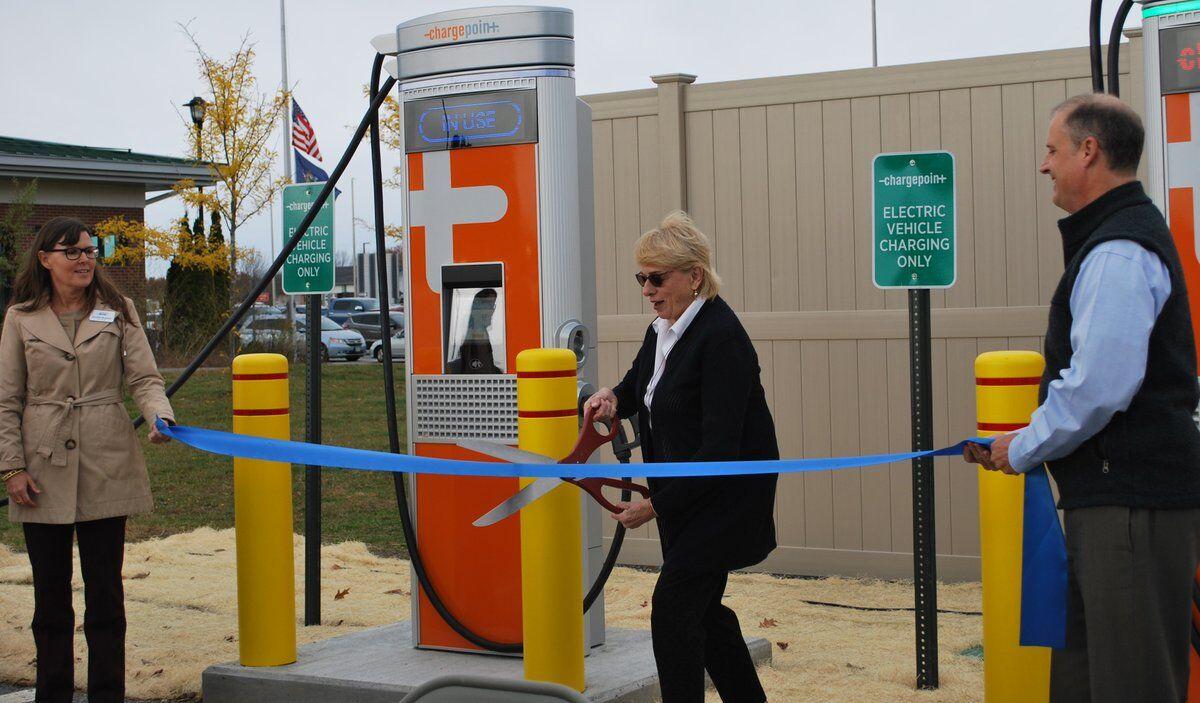
Mills Gardiner

A 2019 ribbon cutting in Gardiner launched Phase 1.

With ReVision Energy’s help, Maine completed the first stage of its critical publicly accessible electric vehicle DC fast-charging (“DCFC”) network! On April 26th, Efficiency Maine and Hannaford Supermarkets hosted a ribbon cutting celebration at the North Windham Hannaford, marking the completion of the last of seven DCFC project locations across Maine. The Hannaford in North Windham joins stations at rest stops in Kennebunk, West Gardiner, and Jackman, and at Hannafords in Skowhegan and Farmington.

These DC high-speed chargers will allow Mainers and tourists to charge quickly and efficiently, thereby extending their vehicles’ range much like gas stations, allowing vehicles to add hundreds of miles of range in 30-60 minutes. No public money was used for this project, as they were funded by part of the settlement money from the Volkswagen lawsuit.

“It was really rewarding to be able to work on these projects which expanded Mainers’ access to fast charging stations from Jackman to Kennebunkport,” said ReVision Energy branch manager Josh Baston, who was Project Manager for the installations. “We at ReVision are excited to continue this effort in 2021 and beyond as we’re already hard at work on the next phases of expanding Maine’s EV charging network.”

Phase 2 will begin on May 12, when Efficiency Maine is expected to announce the locations of the next DC Fast chargers. We anticipate anywhere from 5-7 new sites will be selected. ReVision is hopeful to not only have a role in the installation at some of these sites but also be awarded the chance to own and operate several of them!

These charging stations will help further Governor Janet Mills’ Climate Action Plan, which calls for 41,000 electric vehicles in the state by 2025.

New Hampshire:

ReVision installed several Level 2 Stations at Appalachian Mountain Club’s Pinkham Notch hut and Highland Center.

There are now two 40A Level 2 Charging Stations at Appalachian Mountain Club’s Pinkham Notch hut and four at the Highland Center. ReVision donated these chargers in partnership with NissanUSA and Plug In America to assist AMC in its commitment to become a net zero organization. Plug in and charge while you enjoy the sun and a hike! These are both free to use, with donations accepted.

ReVision Energy also won an RFP from the State of New Hampshire to install, own and operate two Level 2 ChargePoint pedestals (four ports) for public use at the Green Street lot in Concord. These will be ReVision’s first foray into the business of charging itself, and our EV team is looking forward to this project.

“We’re becoming a filling station for clean energy!” said Director of EV Innovation Barry Woods.

Massachusetts:

ReVision Energy is retrofitting Mercedes-Benz of Hanover so that they will be ready for their all-electric inventory, including all-electric vehicles and plug-in hybrids. We’ll be installing 3 charging stations and 2 charger outlets to support their EV infrastructure initiative, so keep an eye out for those!
Filed Under: Under the Sun Blog Tagged With: by Jill McLaughlin, EV Updates

Big Incentive for Business EV Charging in 2020

January 23, 2020 by Ale Moreno

Transportation is the single largest contributor of carbon pollution in our country. With our limited time to address this issue, New England states have wisely begun to create incentives for electric vehicle purchases, making it critical to build adequate infrastructure to support this ever-increasing population of EVs.

Charging at the workplace is the second-most common charging opportunity behind home charging. For those who live in apartments or are without garages, workplace charging can be the deciding factor in going electric. ReVision’s South Portland branch has had 3 co-owners switch to an electric car just in the past 6 months, and our 6 chargers available made their decision that much easier.

Drivers are 6 times more likely to switch to electric transportation if workplace charging is available – regardless of charging potential at home. For companies interested in demonstrating their sustainability values and providing an attractive amenity for their employees, workplace charging is a terrific option.

Better yet, there are financial incentives available to installing charging infrastructure – but they are in place for 2020 so it is prudent to act soon!

If you’re an employee who drives electric or would like to, and your employer does not yet offer charging, please feel free to call us to help you with a presentation, and even a charging policy you can provide facilities managers and decision-makers. If you’re an employer who wants to learn more about incentives, site design, technology choices and costs, give us a call too!

If you already have workplace chargers and would like to host a workplace charging workshop and/or ride and drive, call us for more information on how you can help spread the word! (And are you ready for expansion yet? Many of our customers already are!)

Check out our updated EV Charging Incentives page for Maine, New Hampshire and Massachusetts.

Here are a few websites for additional learning, or check out our classic Workplace Charging Guide .

www.pluginamerica.org www.cleancities.energy.gov

Filed Under: Under the Sun Blog Tagged With: EV Updates

Start Your Batteries! National Drive Electric Week this September

September 6, 2019 by Ale Moreno

All of our branches are excited to participate in National Drive Electric Week – happening in all 50 states from 9/14 – 9/22. Locate an event near you and come view the multitude of EVs available today, and hear firsthand what it is like to own and operate one. There will be test drives!

If you happen to be near Beverly, MA on Saturday, September 14th, come see a version of our solar canopy that can be installed over your driveway and function as a charging station.

Maine:

Falmouth Kittery Portland South Paris

New Hampshire:

Concord Exeter Keene Nashua Plymouth Portsmouth

Massachusetts:

Beverly Braintree Cambridge Western Mass Hilltowns Harvard Hingham Hyannis Ipswich Lowell Northborough Oak Bluffs Plymouth Raynham Tewksbury Wakefield West Boylston

Vermont:

Bennington Bethel Burlington 1 Burlington 2 Grand Isle Montpelier White River Junction

EV Montage

Filed Under: Under the Sun Blog Tagged With: EV Updates

Gov. Janet Mills Announces New Incentives for Electric Vehicles

August 30, 2019 by Ale Moreno

The Chevy Bolt is one of the electric vehicles eligible for a $2,000 rebate thanks to a new Efficiency Maine program

Maine homeowners, businesses, and governments now qualify for rebates from $2,000 – $7,500 for a range of electric vehicles, including the Nissan LEAF (and extended range LEAF Plus), Chevy Bolt, Tesla Model 3, Hyundai Kona and Ioniq Electric, Honda Clarity, BMW i3 electric. Rebates are also available for plug-in hybrids including the plug-in Prius, Chevy Volt, and Chrysler Pacifica van.

Electric vehicles offer a significantly lower total cost of ownership than their gasoline-powered equivalents, and the new state rebate is in addition to up to $7,500 that’s available as a federal tax credit. ReVision Energy also offers special deals for ReVision customers such as a current discount for Nissan LEAFs.

Electric vehicles are also far cleaner than burning gasoline – especially if you drive on sunshine from your own solar panels! The state program, funded by settlement money from Volkswagen as part of their emissions scandal, turns the bad results of that scandal into positive results for the planet.

Full details on the Efficiency Maine website: https://www.efficiencymaine.com/ev/ev-accelerator-available-rebates/

Filed Under: Under the Sun Blog Tagged With: EV Updates

Pape Chevrolet Offers Amazing Incentives for All-Electric Chevy Bolt

March 5, 2019 by Ale Moreno

Exciting news from Pape Chevrolet in South Portland, Maine: 2019 Bolt purchases qualify for either 10% off MSRP, 14% off MSRP if the buyer owns a non-GM vehicle, or 0% financing! There’s never been a better time to go electric!

Upon its release in 2017, the Chevy Bolt earned Motor Trend’s coveted ” Car of the Year ” title, and in the couple of years since, drivers have continued singing praises. Pairing Pape’s deal with the “sunsetting” $7,500 federal EV tax credit, the availability of EV charging rebates in New England, and the incredibly low price of solar makes a strong argument for driving on sunshine in 2019.

Driving on Sunshine

Driving with grid electricity is cleaner and cheaper than gasoline, by far, and when you power EVs with sunshine the cost of driving falls even further to the equivalent of $0.71 cents/gallon of gas.

This “solar gallon” is a slightly conservative estimate based upon average efficiencies of both motor vehicles and EVs, factored with the levelized cost of a typical residential solar array that provides charging – so it’s exciting to mention that it might be cheaper than 71 cents in your case.

The best part? The solar gallon is locked in over the lifetime of your solar array! With a Chevy Bolt, your cost savings on gas will accelerate the payback of your solar investment – and after the array is paid for in fuel savings, you will essentially receive free power for the life of the system. A fixed fueling rate of $0.71/solar gallon is evidence of the unbeatable synergy of solar and EVs.

Purchasing Tips

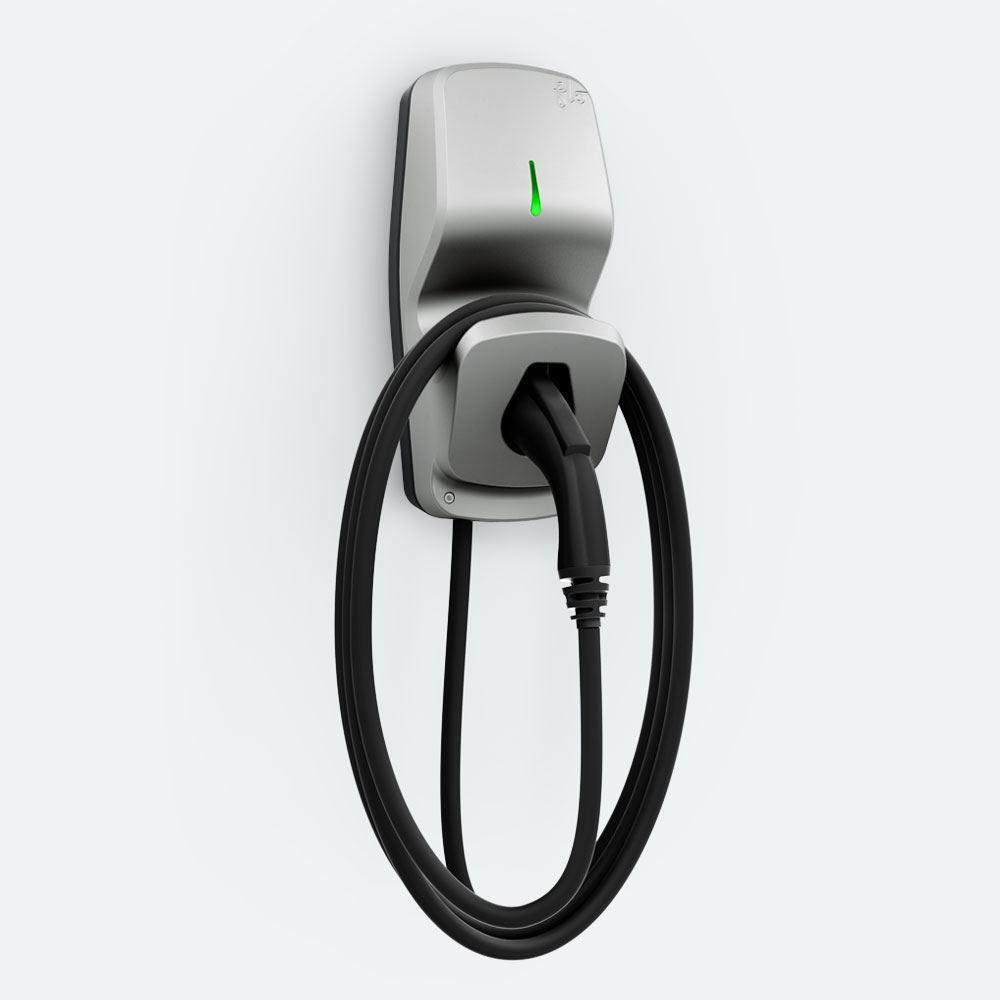
Flo X5 Wall Charger

The FLO Home X5 Level 2 charging station is specially designed for residential homes and is universally compatible with all models of electric and plug-in hybrid vehicles. Its casing is made entirely of NEMA 4X aluminum. Photo courtesy of FLO.

We haven’t even mentioned yet that the Bolt runs at the equivalent of 119 MPG! Range anxiety is fast becoming ancient history. We recommend purchasing your Bolt with a comfort package that provides heated seating and steering – the EPA has rated the Bolt’s range at 238 miles, but cold seats can sap your range via the heater!

However, ReVision has several Bolts in our fleet, and we’ve driven up to 300 miles on one charge. We can attest that the Bolt comes through, even on the coldest days. Most Americans rarely drive more than 40 miles for a day’s commute, but to enable quick long-range travel, we suggest including the DC Fast Charge Port option when purchasing your Bolt. We’ve been busy installing charging all over New England, which has greatly enhanced public access. Take a look at PlugShare’s map and you’ll quickly see the freedom EVs enjoy nowadays.

Further Incentive!

If you want to drive an electric vehicle, you’re going to need an electric vehicle charging point at home, either mounted in the garage or on the driveway. To charge your electric vehicle with solar, you need two components: a solar electric system and a Level II electric vehicle charging station. ReVision Energy can install both for you. Best yet, if you live in Maine, join up with the Future Grid Appliances Pilot to receive a sizable EV Charging incentive. Again, check out our comprehensive EV charging incentive guide for if you live elsewhere in New England.

Give us a call, and head to Pape to test drive a Bolt, pronto!

Filed Under: Under the Sun Blog Tagged With: EV Updates

Maine Coastal Towns Invest in Electric Vehicle Charging Stations to Curb Pollution, Attract Quietude

August 6, 2018 by Ale Moreno

Breaking ground for a new EV charging station in Ellsworth, Maine. A Level II charging station delivers roughly 25 miles of battery charge per hour when plugged into one of the many new electric vehicle models on the road today. One such vehicle, the all-electric Chevy Bolt, has a 240-mile range on one complete charge, zero tailpipe emissions and costs just one fifth of what it costs to fuel an internal combustion engine vehicle.

ReVision just installed several Level II EV charging stations for towns along the Downeast Coastal Corridor in collaboration with A Climate to Thrive. ReVision’s Barry Woods was instrumental in landing a grant for the projects in Belfast, Eastport, Southwest Harbor, Ellsworth and Trenton.

Mount Desert Island is one of America’s most beautiful and beloved national treasures, yet, has some of the Northeast’s worst air quality, mostly because Maine sits at the “tailpipe” of air pollution from coal plants in the Midwest, USA.

Bolstering electric vehicle usage is one step towards reducing the tailpipe effect and making these natural gems as wonderful to breathe in as their jaw-dropping beauty suggests. Whether you’re a Mainer with an electric car or fancy a road trip, check out the expanded infrastructure waiting for you in Downeast Maine.

Filed Under: Under the Sun Blog Tagged With: EV Updates

Town of Derry, NH Installs Free Public EV Charging

June 26, 2018 by Ale Moreno

Via The Eagle Tribune , ReVision Energy installed four charging stations that can accommodate all kinds of electric vehicles in downtown Derry, NH.

“This is something that has been in the works for years,” said Public Works Director Michael Fowler at an earlier meeting, adding the prospect of bringing the electric chargers to town also piqued the interest of many wanting to support the town’s economic development prospects.

That includes supporting the downtown’s restaurants, shops and other businesses that are less than 300 feet from the charging stations.

Fowler said both the town’s Net Zero Task Force and Energy/Environmental Advisory Committee strongly supported the project as well as the Town Council, making it one of the group’s action items.

Filed Under: Under the Sun Blog Tagged With: EV Updates

The Plug-In Hybrid: A More Perfect Union

June 7, 2018 by Ale Moreno

The Honda Clarity Plug-In Hybrid has 48 miles of all-electric range and an electric motor that produces 212 horsepower. Photo courtesy of Honda.

The average American has a commute of 20 miles or less. It just so happens that there are more than a few outstanding plug-in hybrid electric vehicles (PHEVs) that can easily cover that distance without a drop of gasoline. A plug-in hybrid like the Honda Clarity Volt, the Chrysler Pacifica, or the new Toyota RAV4 Prime have batteries that give over 40 miles of range, or more, enabling people to get to and from work without charging.

If you are interested in driving electric, but have reservations about leaving behind a gas-powered engine, a PHEV might be a great fit for you. Though their batteries are smaller than a battery electric vehicle’s (BEV), most are ample enough to cover the everyday distances that many Americans drive. In this way, PHEVs go a step further than the original hybrids, making a proven idea even better.

Why Plug-In Hybrids Make sense

Plenty of cars today can be purchased in PHEV versions, which can eliminate concerns about range anxiety and available public charging in certain areas. Plug-in hybrids’ shorter electric range of between 18 to 42 miles is acceptable when there’s another 300 to 600 more miles on tap from the gas engine. This makes hybrids a great option for people with short commutes, who may only need the gas engine for longer trips or weekend getaways.

All plug-in hybrids can get at least part of the currently available federal income tax credit of up to $7,500. Since it is based on battery size, the credit can vary considerably in PHEVs. A car with a battery of 16.0 kilowatt-hours is eligible for the full $7,500 credit.

The Plug-In Hybrid Rundown

Kia Soul Hybrid Electric Vehicle

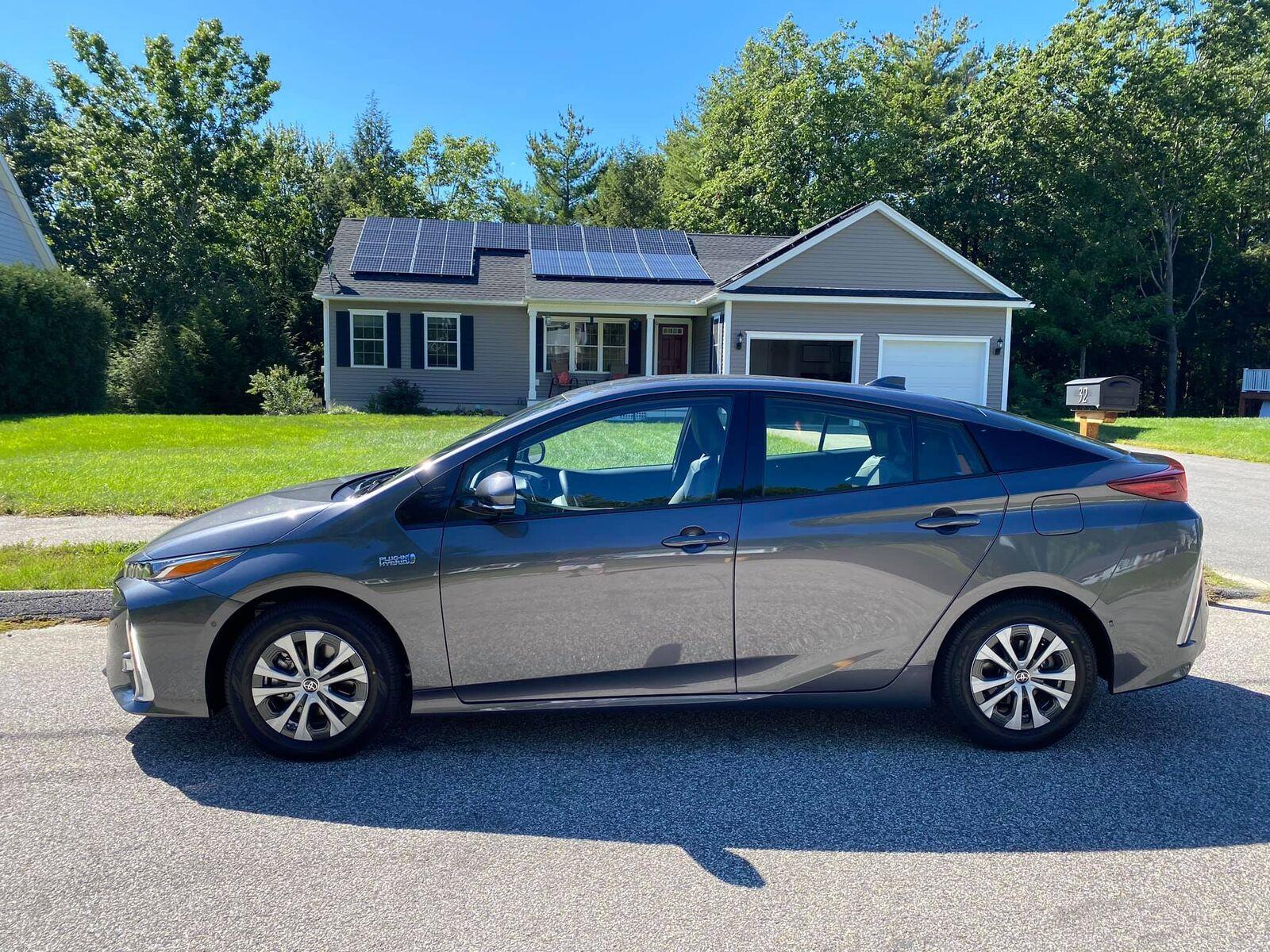
The 2020 Prius Prime, in front of its solar powered home.

PHEVs are a group of cars you might not always notice are operating on electricity. BEVs, like the Chevy Bolt, often look very different from previous gas-powered models, so they’re easy to spot. PHEVs drive on battery power, but still have a gas engine under their hood, and so many models have kept a familiar look.

A plug-in hybrid typically starts up in all-electric mode. When the battery range is gone it switches to gas power. Earlier hybrids will only use their battery capability for shorter distances, and lower speeds, whereas a PHEV driver may not hear the internal combustion engine at all for long stretches of time. Certain PHEVs do still function like earlier hybrids, but not commonly. Whichever is the case, PHEV gas engines are smaller than their predecessors’ and usually much more efficient.

For charging, a PHEV is plugged into a charger, just like a BEV is. Since the battery is smaller, though, it takes less time to recover full range. Level Two charging stations are ideal places to refuel for PHEVs and BEVs, alike. ReVision installs many of these for commercial clients as well as homeowners, as they are a great balance of price and efficiency.

Additionally, PHEVs recover battery range with regenerative braking, which hybrids and BEVs also employ. The energy efficiency of a conventional car is only about 20 percent, and the remaining 80 percent of its energy is converted to heat through friction. Regenerative braking captures as much as half of that wasted energy and puts it back to work, extending range and reducing fuel consumption.

Let’s Talk Range

Half of the highest rated plug-ins go at least 30 miles, which is roughly the length of the average U.S. round-trip commute, according to the Bureau of Transportation Statistics . Toyota’s RAV4 Prime has almost 50 miles of all-electric range. After that, it’s gas motor is essentially made more efficient by the lithium-ion battery, meaning it takes 5.7 seconds to go from zero to sixty, 2 seconds less than the gas engine RAV4.

There are a variety of other options available today, offered by Honda, Volvo, Kia and Ford, among others. Many PHEV drivers, including ReVision co-founder Phil Coupe, report that they hardly ever need to run the gas engine. Though, when they do need it, it’s there, seamlessly.

“I’m doing 90% of my driving on pure solar power stored in my van’s battery. All my work commuting, grocery store trips, school drop-offs, kids’ sports activities and other local errands are handled by the battery. If I drive to Boston, the first 38 miles are on battery and then the gas back-up seamlessly kicks in to take me the rest of the way,” said Phil Coupe, who first leased a Volt six years ago and now drives the Pacifica plug-in hybrid van.

Attainable Change

We’re all looking to do more to reduce our carbon footprint, and using cleaner transportation is a huge opportunity to make a difference. While not free of tail-pipe emissions, a plug-in hybrid largely relies on (increasingly cleaner) electricity. It’s not just cleaner to drive on grid electricity in all 50 states, it’s cheaper too.

Right now, gas across the USA is nearly $3/gallon, while the Department of Energy places the eGallon at the equivalent of $1.16/gallon . Why stop there? The savings grow even further if you pair a PHEV with solar. Solar and EVs work synergistically to accelerate your ROI, and together they deliver a fixed fueling cost of $0.71/gallon over the lifetime of your solar array .

Read our guide to solar and EV charging in Part 3 – Solar + EV: Drive on Sunshine, Save Big Bucks !

Filed Under: Under the Sun Blog Tagged With: EV Updates

Solar + EV: Drive on Sunshine, Save Big Bucks

September 7, 2017 by Ale Moreno

Part 3 of 3: Solar and EVs

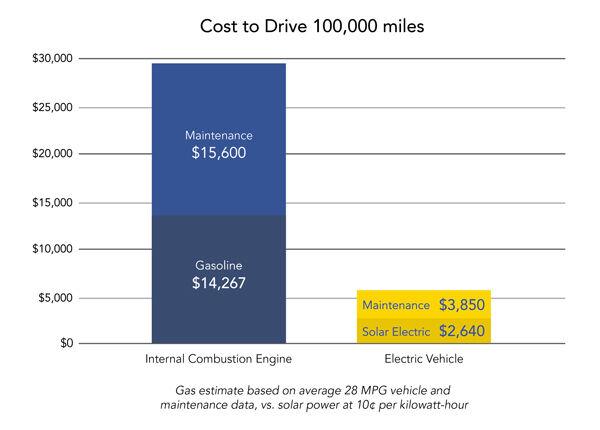
In addition to fuel savings, EVs are free from many routine maintenance items that must be replaced in a gas-powered car. These include parts (spark plugs, mufflers, belts, water pumps, and batteries) as well as fluids (transmission fluid, engine oil, coolant, and, well, gasoline).

We rely on cars. Cars bring us to work, to Hannaford, or around New England to explore mountains and coasts. We make serious investments into owning cars with a good reputation, and we spend a lot of money to make sure they stay in motion. Now, electric vehicles, particularly when powered by the sun, have improved the cost of reliability forever.

What is the real cost of owning a gas-powered vehicle? None of us are oblivious to prices at the pump, but we might be surprised that we spend as much as $20,000 on gasoline over the lifetime of our cars. Fuel aside, maintaining and repairing a motor vehicle can also cost thousands, all told. These expenses accumulate with both mundane regularity and messy unpredictability, month after month, year after year.

Are you ready to put that money back into your pocket, reduce your power bill, and increase the value of your home?

EV Cost Savings Over Internal Combustion Engine Maintenance

Oil has really been the only option for most people for a long time, but it’s destructive to extract and consume our ultimately finite reserves. In the last decade, the market has changed course toward a cleaner, more efficient solution that saves money: Electric transportation.

Indeed, the shift in America’s auto market has already begun. The concept is proven – the technology works, and is only getting better.

Electric Vehicles: Faster, Better, Stronger

Electric vehicles have inherent advantages in efficiency and torque over gas-powered vehicles. Energy storage-to-torque on an EV platform is above 90 percent efficient, compared to less than 35 percent for internal combustion engines. EVs don’t need gears – all their torque is available, all the time. Let’s just say, EVs are quick.

Unnamed

Fewer parts means lower service maintenance needs and cost.

Though speedy, EVs are far more peaceful than cars with internal combustion engines, which are basically experiencing a bunch of explosions under the hood. They have about 100x fewer moving parts, the absence of which results in far less maintenance needs and lower service costs . No more thrown belts, blown gaskets, cracked cylinder heads, or spun rods. No more oil changes.

EVs are safer, too. Crash-test dummies prefer EVs due to large, frontal crash-protection crumple zones (no engine block), “double bumpers” (a Tesla feature), low centers of gravity (lithium-ion battery placement), and, of course, the lack of a flammable tank of fuel (adios gasoline).

Those fuel costs we mentioned earlier? EVs cut that expense in half. In fact, electricity is significantly cheaper than gas in all 50 states. Better yet, if you change the equation by installing a PV system to charge your EV, costs shrink to about a third of current gasoline prices.

One day soon, efficient EVs will merge with autonomous driving software that will make the cars of tomorrow safe, green, and connected. This convergence is a logical progression as autonomous driving technology improves. EVs are great for ride-sharing programs in population centers where charging infrastructure is abundant, and it is easier for computers to drive electric vehicles.

The Solar Gallon

EV mileage is discussed in terms of MPGe (Miles per gallon gasoline equivalent), comparing the energy content of gasoline to electricity, and the eGallon, representing the cost of powering a vehicle with electricity compared to fueling a similar motor vehicle.

Most all-electric vehicles on the market are capable of over 100 MPGe, and with the average eGallon price of $1.85 in Northern New England, it’s easy to visualize significant savings. But what about the solar gallon? It’s like the eGallon, but thanks to solar power it emits no carbon, has no significant hidden environmental costs, and leaves a much lighter footprint on society at large. A solar gallon also happens to cost $0.84.

The solar gallon is a slightly conservative estimate based upon average efficiencies of both motor vehicles and EVs, factored with the levelized cost of a typical residential solar array that provides charging – so it’s exciting to mention that it might be cheaper than 71 cents in your case.

The best part? The solar gallon is locked in over the lifetime of your solar array! With an EV, your cost savings on gas accelerates the payback of your solar investment, and after the array is paid for in fuel savings, you will essentially receive free power for the life of the system. 

Mark Boren Solar Powered Nissan Leaf

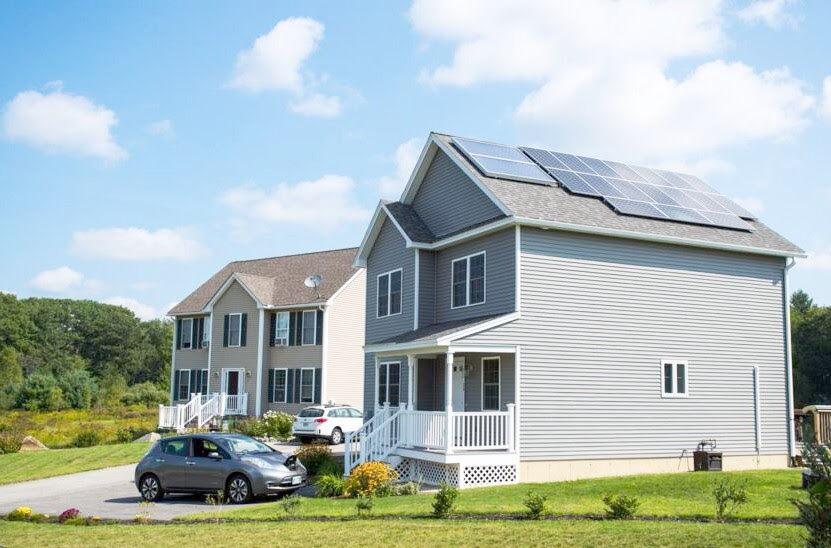
Switching to electric transport leads to the next logical thing: powering those miles on sunshine. Here, #SolarChampion Mark Boren recharges his Nissan LEAF off the solar panels of his Dover, NH home.

When you pair solar power with EVs, you break the connection between driving and carbon pollution created by utilities to produce electricity, and you step toward energy independence. This holistic approach sees PV charging and EVs as two parts of a whole. By budgeting a PV system as part of an EV’s cost, you create a valuable charging package that gives you a better return on investment, and produces free energy for your car and home for years to come.

With electricity, we now have a choice as to how to power our cars. Using electricity produced within the United States for our transportation needs is a big leap away from reliance upon foreign oil, and when we use locally generated solar electricity to power vehicles – drastically reducing the greenhouse gases involved before – we leap to where we really ought to be.

Driving on sunshine is the fullest realization of EVs on the road. By unifying solar and Evs, we create enormous savings, greatly reduce environmental harm, and strengthen America’s energy independence – that, is the world’s first truly reliable car.

Ready to combine solar and Evs? Reach out to our talented solar team and get started!

Filed Under: Under the Sun Blog Tagged With: EV Updates

The Ins and Outs of EV Charging

July 29, 2017 by Ale Moreno


Part 2 of 3

In Part 1, we talked about the history of Electric Vehicles and how that history influences our future.

Electric vehicles are rapidly becoming better, cheaper, and cleaner than their fossil fueled equivalents (see: The Last Auto Mechanic ), and so is the charging infrastructure that supports these vehicles.

In this installment we delve into electric vehicle charging infrastructure and how the hand-in-glove combination of new technology and new EVs is accelerating the clean energy transition.

Charging Up

One of the most obvious features of an electric car is the need to replenish the battery by charging it!

A lot of consumer anxiety around electric vehicles has to do with charging – how long will a vehicle go on a charge, how long will it take to charge, where can I get a charge, etc. The great news is that electric vehicle charging stations are easier to operate than a gas pump, much cleaner in every way possible, and charging stations are popping up like mushrooms after a spring rain throughout New England and beyond. (see: PlugShare ).

With the help of Volkswagen emissions scandal settlement money, we have been able to build out more of the necessary charging infrastructure to enable the end of the internal combustion engine.

Here are some quick facts you need to know about how easy and convenient it is to charge your EV:

  • Most passenger vehicles sit unused for 95% of every day, either parked at home or work, which is plenty of time to refuel!
  • EV’s can be charged overnight while you sleep – making commuting via electric vehicle an existing reality for millions of people.
  • An increasing number of employers are offering workplace charging as a free or nominal cost benefit – extending one’s range even further.
  • Public and commercial charging stations are everywhere! Apps like PlugShare make them easy to find.
  • ReVision Energy offers installation of Electric Vehicle Chargers – Level One and Level Two for home, business, municipal, and nonprofit applications. Empowering people to recharge their electric vehicles is an immediate win over burning gasoline, and even better when combined with solar!

On the Level

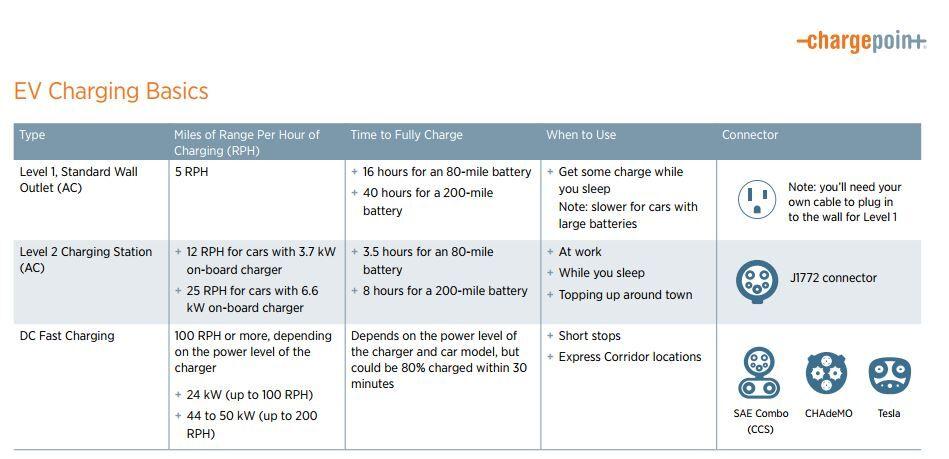
Electric vehicle charging equipment is categorized in one of three categories, based on speed of recharge:

Level One Charging

The simplest way to recharge an EV’s battery – every home already has it! Using a standard 120V alternating current (AC) plug, a Level One charger delivers about 5-8 miles of range for every hour your EV is plugged in. Most EVs ship with a Level One charging plug with the car. While super convenient, this is also the slowest method of charging.

A Level One charger can be sufficient, depending on your driving habits. Most homes find they require quicker charging options, but if your commuting needs are limited, this method may work out just fine.

Paris Charger
Level Two Charging

A great combination of charge rate and price of install, Level Two charging uses commonly available 240V AC power (similar to a dryer) and typically delivers 4-5 miles per hour of charging. A 2017 Chevy Bolt, for example, takes only 8.5 hours (overnight) to recover its 238-mile range with a Level Two charger.

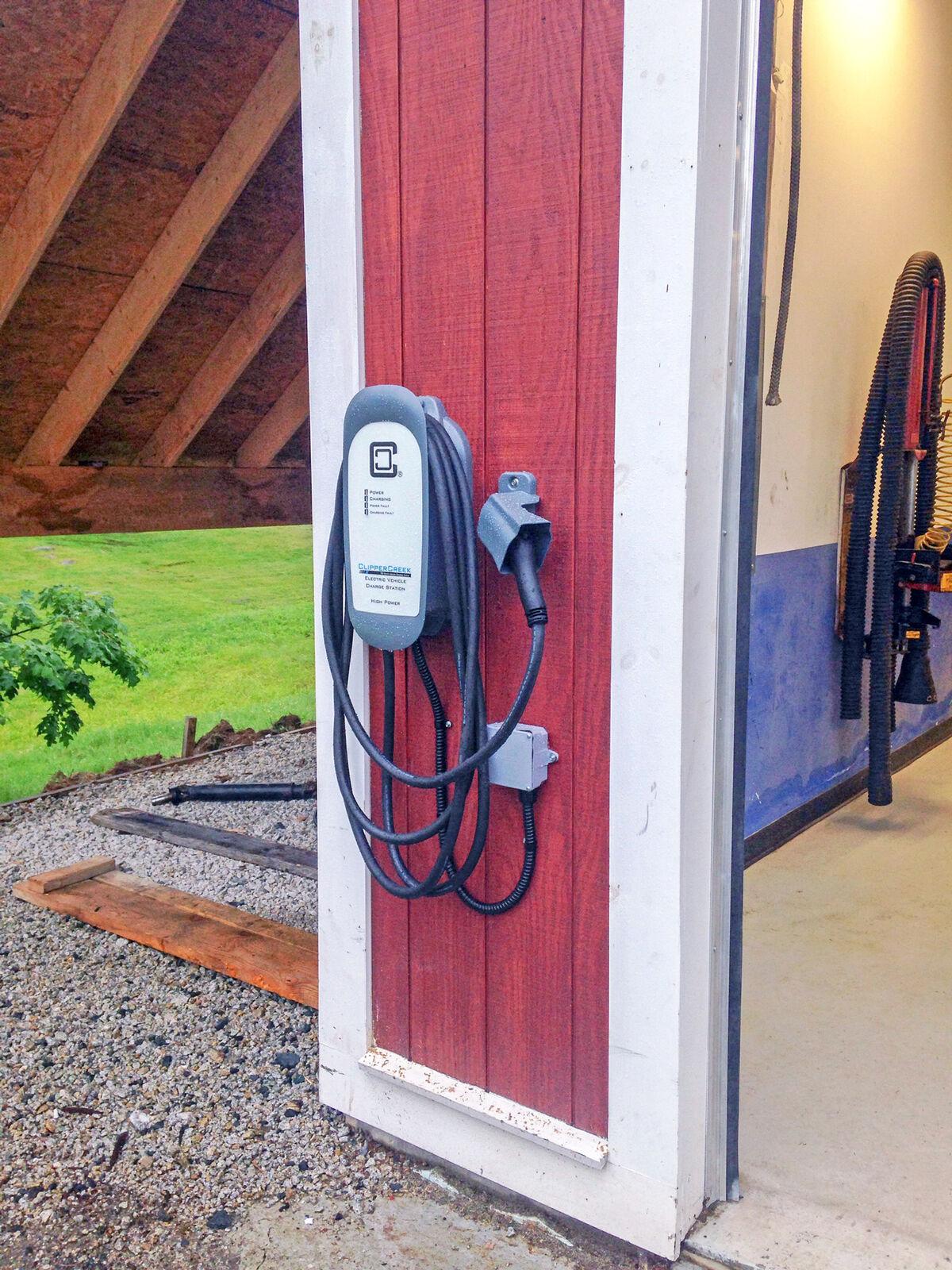
For the vast majority of homeowners, and many businesses as well, Level Two charging is the right option. Charging stations by ClipperCreek are a cost-effective option that come in many different models and individual variations, and are compatible with virtually all EVs on the market.

Level Three – DC Fast Charging

Level Three charging is a completely different animal from Level One and Two, since it deals with direct current rather than alternate current. There are a few different flavors of DC Fast Charging, which refer to charging equipment which bypasses the vehicle’s onboard charger and charges the vehicle’s battery directly (Level Three is not a precisely accurate technical term but we use it here to make the varieties of charger clearer).

For example, we’ve installed a set of Direct Current Quick Chargers (DCQCs) for several Hannaford Supermarkets locations in Maine. These DCQCs bind together two 240V circuits to create a single 480V charging circuit, allowing an EV’s battery to be recharged at a rate of around 150 miles of range per hour

Quick chargers are the technology choice you’ll see at highway rest stops (we’ve installed them at the Kennebunk and Gardiner rest stops on I-95 in Maine), parking garages, and other locations where it is unrealistic to expect customers to stick around for 4-5 hours to recharge their vehicle. While much more expensive, the time benefits are remarkable, and DCQCs are the technology that will enable truly long-range drive times with electric vehicles.

Seem far-fetched to drive coast to coast on batteries? It shouldn’t! It’s already possible for Tesla owners – Tesla’s proprietary network of “Superchargers” already make it possible to drive from Lubec, Maine to San Diego, CA on electricity only.

Chargepoint Guide To Ev Charging

Gallons of Sun

Like the idea of filling up for the equivalent of $1.85 per gallon? Well, with solar and electric vehicles, that’s a reality!

Electricity is only as clean as its source, and combining EVs with solar breaks the connection between driving and carbon pollution created by utilities to produce electricity. The powerful combination of EVs and solar energy renders a charging package that can lock in your energy costs for years to come, as well as creating the strongest return on investment for your solar array.

How do we get to $1.85 per gallon? Well – EVs receive a mile per gallon equivalent (MPGe) from the EPA based on how many kilowatt-hours (kWh) it takes for the vehicle to drive 100 miles. Similarly, there is the eGallon, which represents the cost of powering a vehicle with electricity compared to a similar motor vehicle. Using the average fuel economy and energy efficiency of motor vehicles compared to EVs, and the adjusted price of electricity generated by solar power, the cost of “fueling” an EV in Northern New England is roughly equivalent to paying $1.85/gallon for gasoline!

If you drive an EV powered by your solar array, the cost of the solar panels shifts from displacing the expense of utility-supplied electricity to displacing the expense of ever-fluctuating gasoline prices. Once you’ve paid off your solar array with a better return on investment, the energy produced for your car becomes free, for years.

Read on to learn more about the power of the solar gallon in Part 3: Drive on Sunshine, Save Big Bucks .

Filed Under: Under the Sun Blog Tagged With: EV Updates

On the Road Again: The Return of the Electric Vehicle

June 30, 2017 by Ale Moreno

Part 1 of our 3 part guide to Electric Vehicles and their Solar Powered Future

The Columbia Mark 68 Victoria electric vehicle, made by the Pope Manufacturing Company in 1906, is one of the earliest automotives of any kind and marked a moment where humans could have launched an electrical rather than fossil fuel era. Over a hundred years later, a confluence of consumer demand, fossil fuel realities and technological advances have created momentum for the return of electrical locomotion. Photo Courtesy miSci.

First in motion in the United States over 100 years ago, the electric vehicle (EV) is, at long last, having its day in the sun. With over a dozen all-electric vehicles on the market today, and manufacturers committing billions to research and development, the transition to zero emission vehicles is accelerating.

Electric vehicles were initially a very viable option for many in need of urban transportation in the late 19 th century. Steam, electrical, and gasoline power were all present in this experimental period as the world underwent a paradigm shift from horse-powered personal transportation to “horseless carriages,” as early car prototypes were dubbed, but electricity was the clean and quiet option many preferred.

By 1900 many innovators around the world were exploring ways to improve the technology. In the first years of the century, Thomas Edison, who believed that electric vehicles were the logical champion, worked toward increasing their battery capacities. Even Henry Ford was open to their potential, and, in partnership with Edison, considered producing a low-cost electric vehicle.

Despite his interest, it was the rollout of Ford Motor Company’s Model T, in 1908, that delivered a substantial blow to any marketable electric vehicle. Inexpensive, mass-produced Model T’s, absent a laborious crank-starter, and the Texas crude oil boom, gave rise to the gasoline-powered motor vehicle. Along with filling stations, motor vehicles spread out from cities into rural America, where electrical infrastructure had not yet arrived.

1922 was the apex of horse ownership in America, and 120,000 people were employed in the harness-making industry. By 1928 the automobile had become dominant, wiping out the harness-makers, but unleashing decades of exponential job growth and economic development associated with the U.S. auto industry.

Gas prices remained low, and the American automobile industry flourished without much of a mention of the electric vehicle, until the 1960s when the Environmental Movement began influencing legislation to help clear the increasingly smoggy, unhealthy air Americans were breathing as a result of motor vehicle emissions.

Oil Shock

Gas Station Attendants Peer Over Their  Out Of Gas  Sign In Portland   NARA

Portland, Oregon gas station attendants in 1973. Photo courtesy U.S. National Archives and Records Administration.

It was the oil crises of the 1970s that truly brought the electric vehicle back into consideration, though – Americans were suddenly finding themselves at the mercy of foreign oil interests, and many recognized that revitalizing the development of a swift, long-range EV was the solution.

A couple of automakers created prototypes, and Congress even authorized government support of research and development. But, by this time, much of America was enamored with the rumble of a motor, and with their limited speed and range, and often unusual appearance, these EVs did not reach the necessary broad appeal to advance, and their slight popularity diminished again in the 1980s.

Then, in 1996, spurred by strict emissions regulations issued in California earlier in the decade, General Motors began leasing the first mass-produced electric vehicle of the modern era from a major automaker: the EV1. Customer reactions were very positive – it could keep up on the highways and travel as much as 100 miles on a charge.

EV1

The GM EV1. Photo courtesy Motor Trend .

Other major automakers attempted to follow suit in order to continue selling vehicles in California, but sadly this technological momentum was again hindered, this time by relentless pressure from entrenched oil interests, attacks of misinformation, and even interference from former president George W. Bush’s administration.

GM declared the EV1 commercially unviable due to high production costs, and by 2003 the EV1 program had been discontinued, and leased models were removed from the road, then, largely, destroyed.

Surging Forward

After another initially hopeful chapter concluded so dismally, it might seem like the notion of an electric vehicle was ill-fated – but you can’t keep a good idea down. Consumer demand continued to grow with increasing environmental awareness, while the photovoltaic technology to harvest a clean energy supply, and the battery technology to store it, began to leap ahead, as well.

Companies like Toyota and Honda produced HEVs (hybrid electric vehicles) that were well-received and affordable, but they were not free from the world of oil, emissions, and engine maintenance. Then, in 2006, along came the Tesla Roadster – the first mass-produced, all-electric vehicle to reach the American market in the decade since the EV1’s arrival.

IMG 1633 Edit

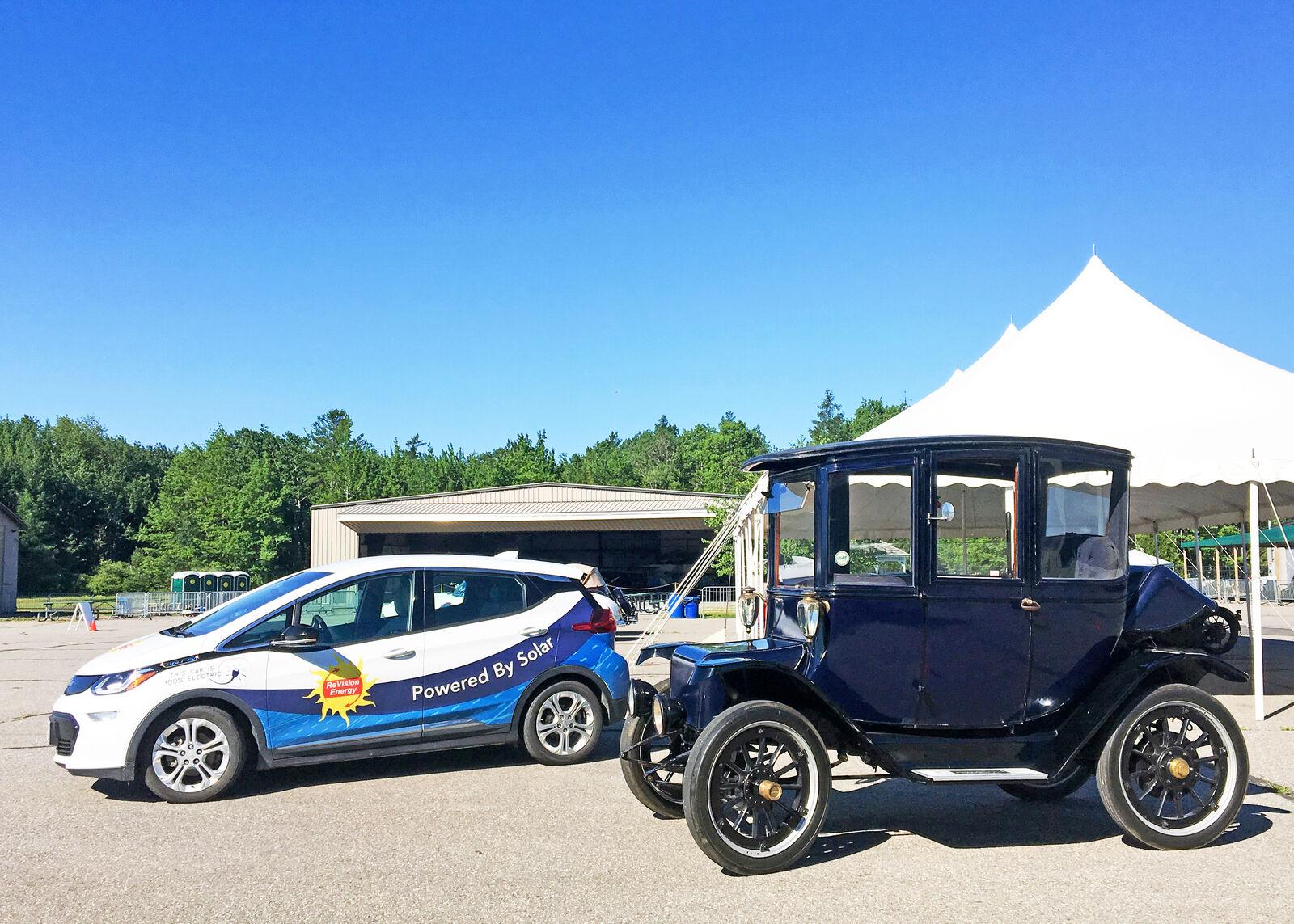
A 2017 Chevy Bolt next to a 1912 Woods Electric Brougham. This 100+ year old EV may have only had a top speed of 20 mph, but it also had 100 miles of range!

Tesla’s Roadster and their S sedan have been extremely successful, and they have more all-electric models in the works, compelling other major automakers to renew their efforts in the research and development of the modern EV, with more and more of them producing HEVs and PHEVs ( plug-in hybrid electric vehicles ) to fill the gap. Now, in 2022, everyone from BMW to Ford has produced an all-electric vehicle – the Nissan Leaf and Chevy Bolt are two of the most affordable and competitive of these EVs on American highways today, each pushing the other ahead.

Additionally, hybrid cars have continued to evolve and keep a strong presence in the market, giving even more options to homes looking to electrify their transportation. In 2021, plug-in hybrids (PHEVs) accounted for a fifth of the total electric vehicles sales in the US. Hybrids are made by nearly every manufacturer, and options abound in style, function, and cost. You can read our post on plug-in hybrids to learn more .

The electricity we drive on is only as green as its source, however, and efforts to further improve battery technology, and widely distribute clean solar energy are vital to the overall success of the EV. Moreover, installing charging infrastructure, reducing charging times, and increasing driving ranges are all essential to winning over American drivers and transforming our auto industry. Our clean energy transition is far from complete, but the American psyche has already begun to embrace the next paradigm shift in transportation – driving on sunshine!

Read on to learn about Electric Charging and the solar gallon in Part 2: The Ins and Outs of EV Charging.

Filed Under: Under the Sun Blog Tagged With: EV Updates

  • « Go to Previous Page
  • Page 1
  • Page 2
  • Page 3

sidebar

sidebar-alt

Subscribe to newsletter

Which newsletters would you like to receive?

Consent Enjoy the Sun(Required)
Consent(Required)
To provide the requested information, we need to store and process your personal data. By submitting this form, you agree to allow ReVision Energy to store and process your personal data for this purpose. Please see our privacy policy for more information.

  • Merch Store

Sitemap

  • Solutions
    • Homes
    • Commercial
    • Service
  • Our Work
    • Projects
  • About
    • Our People
    • Social Impact
    • Our Locations
    • Careers
  • For Customers
    • Support & Service
    • Be A Solar Champion
  • News & Events
    • Releases
    • Press
    • Under the Sun Blog
    • Events and Webinars
  • Our Partners
  • Resources

Follow Us

General Contact

Contact one of our branches for sales and non-service inquiries, or email us at hello@revisionenergy.com

Service

Need support for your existing system? Contact our Service Team:
Reach us at (207) 747-0076 or open a Support Ticket.

South Portland, ME

(207) 221-6342

Map & Directions 

Montville, ME

(207) 589-4171

Map & Directions 

Brentwood, NH

(603) 679-1777

Map & Directions 

Enfield, NH

(603) 632-1263

Map & Directions 

North Andover, MA

(978) 308-9041

Map & Directions 

Westfield, MA

(413) 884-1000

Map & Directions 

Copyright © 2026 ReVision Energy. All rights reserved.

Privacy Policy | Terms