• Skip to primary navigation
  • Skip to main content
  • Skip to primary sidebar
Revision Logo Revision Logo
Solar Calculator Get Started
Get Started Solar Calculator
  • Solutions
    • Homes
    • Commercial
    • Service
  • Our Work
    • Projects
  • About
    • About
    • Our People
    • Social Impact
    • Our Locations
    • Careers
  • For Customers
    • Support & Service
    • Be A Solar Champion
  • News & Events
    • Releases
    • Press
    • Under the Sun Blog
    • Events and Webinars
  • Our Partners
  • Resources

Give us a call

Maine (207) 221-6342
New Hampshire (603) 632-1263
Massachusetts (978) 308-9041
Contact Us

Value of Solar

Solar Payback Periods

September 9, 2025 by Ale Moreno

We often get questions about the “payback period” on solar investments. At ReVision, we believe it’s important to take a holistic approach to evaluating the value of solar. Keep in mind that solar has been proven to increase home resale value, and is a more reliable investment than the stock market.

So while “payback period” shouldn’t be the only metric we discuss, we understand it’s a frequent topic of conversation. We show all of these numbers in our proposals (and more), to help you fully understand the long-term savings potential and wealth creation that renewable energy offers. Put simply, your solar payback period is the amount of time it takes for you to “break even” on your solar investment. This means calculating the time it takes for you to save as much on your electric bills as you spent on your solar energy system. 

2026 and Beyond

Although the federal tax credit for solar has been taken away, the solar payback period is actually the same – if not better – than it was five years ago. The cost of solar technologies has dropped 75% in the last ten years, while the cost of electricity has increased exponentially. (This is due to a number of factors including natural gas prices, increased storm damage, and aging transmission lines – check out our recent blog post for a deep dive into electricity rates).  

Relying on your utility for 100% of your electricity means you have no protection from their increasing rates, which have more than doubled over the past 20 years in New England. With a solar investment, you pre-buy your own clean electricity, which means your “solar electric rate” can only go down over time; the longer you use it, the cheaper each individual kWh becomes. Instead of worrying about electricity rates rising, go solar for a fixed amount and benefit from reliable, clean electricity for decades to come. 

Our co-founder Fortunat Mueller was recently interviewed about this on Maine Public:

The fundamentals and economics of rooftop solar for residential customers are still really really strong. There are forces making it a stronger, better investment even than it has been in the past. We’re finding that customers signing up for 2026 installations are getting just as good a deal overall in terms of lifetime value for their systems.  

The cost of electricity is going up at an accelerating pace, and there are a number of factors playing into that. So for a homeowner thinking about generating some of their own electricity on the roof, the argument for solar (in terms of increasing grid costs and decreasing reliability), is stronger than ever.”  

Below are examples that prove this argument, pulled from real proposals, designed in August 2025 by our local Solar Designers. These projects will be installed in 2026, meaning they do not include the former federal tax credit. Our proposals include everything from panel degradation to utility cost increases, and our projections tend to be conservative. 

Maine:

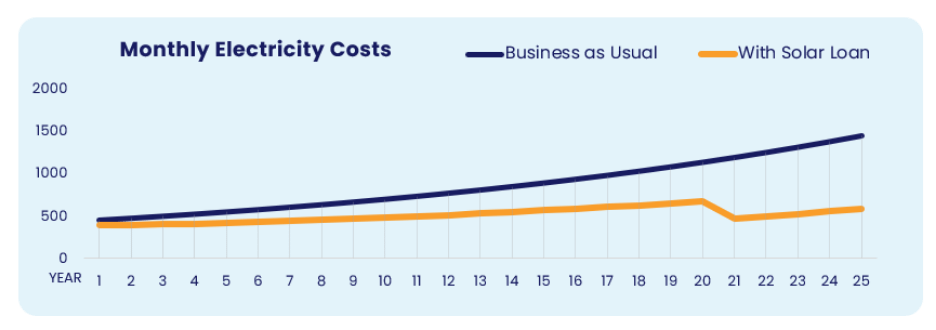
Here’s another recent example from a customer in Maine, we’ll call her Laura. Laura has four kids living at home, heat pumps, an electric vehicle, and a swimming pool – her family uses a lot of electricity. Her average monthly electric bill in 2025, at CMP’s current rate of $0.24/kwH, is $450. If she does nothing, and electric prices rise a conservative 5%, Laura can expect to pay $257,500 over the next 25 years.  
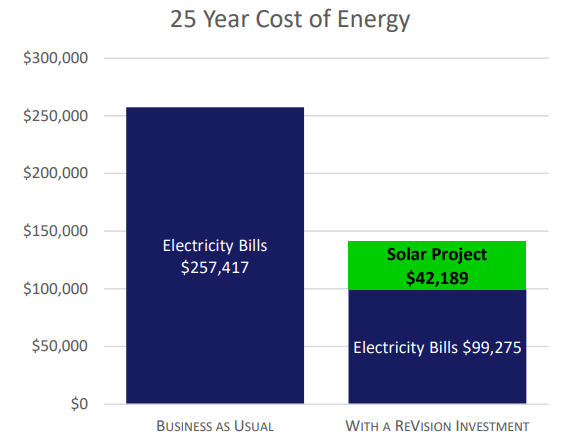
Laura’s solar array will cost about $42,000 total. Because of her roof orientation and shading, her array will only offset 65% of her home’s electric load, so she will continue to pay CMP for some electricity every month. This is still a huge financial win for Laura and her family:

 Her solar “payback period” is 10 years, and she will pay an equivalent of $0.10/kWh – less than half of what she was paying to CMP in 2025.  
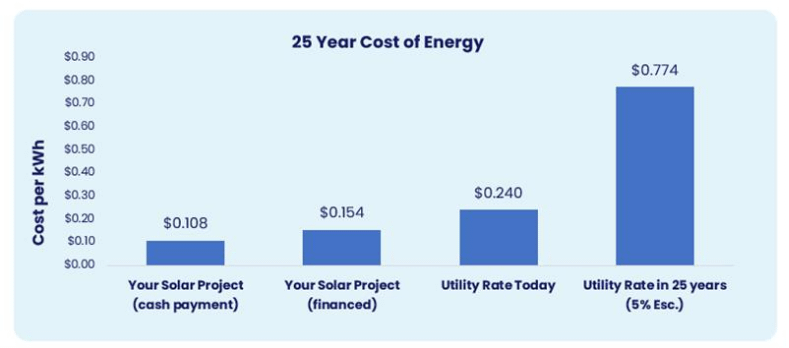
Laura’s total net savings with solar over 25 years? $116,000.  
 

Massachusetts: 

Our Massachusetts customer, Alex, has an even better payback period: 7.7 years. Alex’s currently monthly electric bill is $154, meaning she can expect to pay $108,000 to National Grid in 25 years if her usage stays the same. But Alex is planning to get an EV in a few years, and is also considering switching to air source heat pumps – both of which will increase her electric bill. 
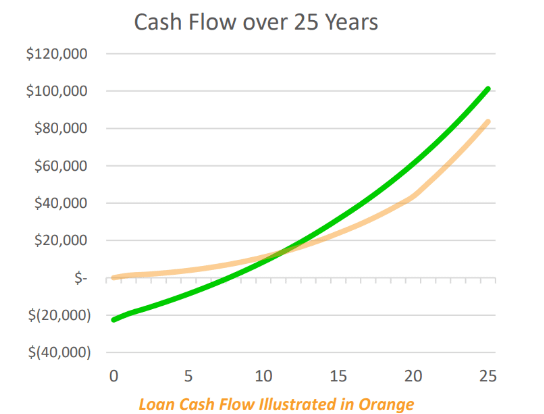
We designed a rooftop solar array for Alex that will actually cover 115% of her current electric usage, leaving room for her future EV and heat pumps. Her total project cost will be $22,500, but unlike our other states, Massachusetts does have state-specific incentives, bringing her cash investment to roughly $18,900. She’ll earn that back in utility savings in just 7.7 years and will have saved over $101,000 in 25 years (not to mention the money she will save on gas by switching to an EV and heat pumps). 

New Hampshire: 

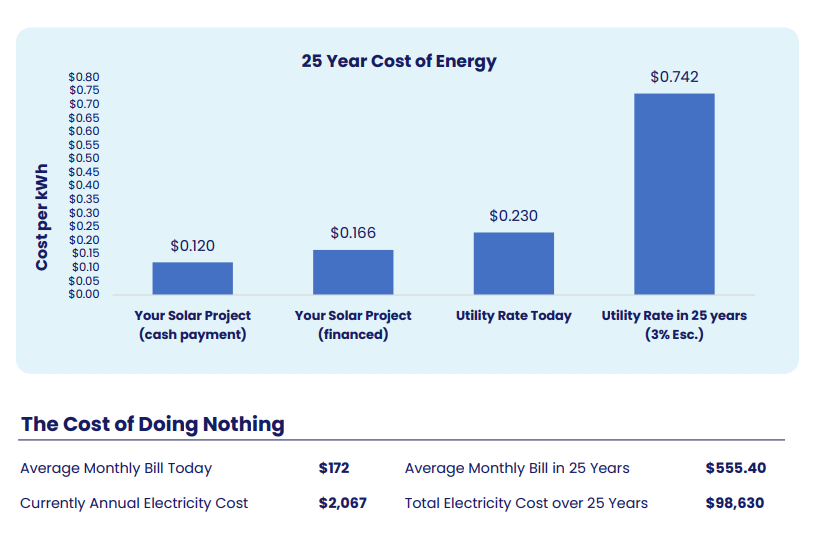
Let’s call this customer Simon. Simon currently pays an average of $143/month for electricity from Eversource. Based on our conservative projections for utility increases, Simon can expect to pay $81,900 to Eversource over the next 25 years.

A solar array on his roof will cost Simon $23,734, but the energy generated from those panels will almost entirely cover his home’s usage. Simon can either pay for the solar project in cash now, or take out a loan. Even after he pays the interest on the loan, Simon will ultimately be saving over $50,000 on energy costs for the next 25 years.  

His solar “payback period” – the time it takes him to recoup his initial investment – is 10 years, meaning he will get 15+ years of nearly-free electricity.  
NH PV Chart 2026.png

Making a solar investment means your cost of electricity can only go down over time. Lock in your solar electricity rate today. 

Filed Under: Under the Sun Blog Tagged With: by Jill McLaughlin, Value of Solar

Buying a Home with Solar Panels

June 4, 2024 by Ale Moreno

Buying a house is a big step. When that house comes equipped with solar panels, it adds value and sustainability to your purchase. Solar panels offer many advantages, making them a compelling feature for any homebuyer. Here’s how you can make an informed decision about purchasing a home with solar panels.  

Why Buy a Home with Solar Panels? 

Buying a home with solar panels will lower your electricity bill and carbon footprint, and increase your home’s resiliency and value.

  1. Lower electricity bill:

    One of the biggest perks of solar panels is the savings on your electricity costs. Solar energy can cover a significant portion of your home’s energy needs. Depending on your location, sun exposure, and energy usage, you’ll see your electricity costs drop significantly.

  2. Decreased carbon footprint:Solar panels harness the sun’s energy, reducing reliance on fossil fuels. They produce clean, renewable energy, helping the environment by lowering greenhouse gas emissions.

  3. More resilient: With solar panels, you’re less dependent on the national power grid. Solar shields you from future utility rate hikes, allowing you to lock in a stable electricity price for years.

  4. Increased home value: Homes with solar panels often have a higher market value. Studies show that solar-equipped homes can sell for 4.1% more than similar homes without solar. Solar panels are viewed as valuable upgrades, like a new kitchen or a finished basement.

  5. Ideal for EV owners: Solar energy can charge your EV, cutting down on your electricity bills. You can power your car directly from the sun, avoiding rising electricity rates. Plus, it’s a great way to reduce your carbon footprint.

Questions to Ask    

Before you buy, there are some important questions to ask.  

Who owns the panels?  

assessing a home with solar panels.jpg
What if the seller owns the panels?  

If the seller owns the solar array, that’s great news! You won’t have any ongoing lease payments, and you’ll have complete control over the system. If you’re considering a home with ReVision-installed panels that are still under warranty, we will waive labor expenses incurred to troubleshoot, repair, or replace any faulty solar products incorporated into your solar installation.  

What if the seller leases the panels? 

If you’re considering buying a house with leased solar panels, you’ll likely need to take over the lease payments. It’s possible to make your purchase offer contingent upon the seller paying off the lease before closing. Make sure you understand the lease terms and how they impact your budget. The leasing company usually handles maintenance and repairs, so check the service agreement for details. Also, make sure the lease transfer is appropriately documented and approved.  

Who installed the panels?  

Who installed the panels.jpg
What if the panels were installed by a licensed professional? 

If installed by a licensed professional, the installation company can tell you about the system’s age, past maintenance, and purchase terms. If the original installer is out of business, identify the solar panels and inverter manufacturer. Then, contact a certified local installer to see if they know the model and can inspect the system.  

What if the panels were self-installed?

If the array was self-installed, check with the seller to see if the system has a manufacturer’s warranty and is still valid. Self-installed systems might have a higher risk of issues, so consider getting a professional inspection.  

How old are the panels?  

How old are the panels (1).jpg
What if the system is nearing the end of its life?  

If the solar system is nearing the end of its usable life, you’ll need to consider a few things. Get quotes for replacing the panels and check if the inverter needs an update. Modern panels offer better performance. Plan for the safe removal of the old system. If it’s a home with ReVision-installed panels, our service team ensures they are removed responsibly and not thrown into a landfill. We can help you navigate these steps and find the best solution.  

What if the system isn’t nearing the end of its life?

Remember, solar installations last 30 to 35 years. If the solar system isn’t nearing the end of its usable life, that’s a big plus! Estimate how many more years it will work efficiently and review its maintenance history to ensure the system has been well-cared for. Ask to see a few months of electric bills and check the system’s energy output to verify it will meet your needs.  

What about warranties?   

There are generally two kinds of warranties for solar installations: workmanship and manufacturer. Workmanship refers to the physical installation and wiring of the system. Manufacturer warranties cover equipment in case of product failure during the warranty period. Warranties can be transferred with the sale of a property, so discuss the status and transfer of the warranties with the seller.   

Check with the installation company to see who covers the workmanship and manufacturer warranties. At ReVision, we cover our workmanship warranty with our 24/7 in-house service department. Many solar installers use third-party companies to cover their warranty offerings. Sometimes these warranties come with fine print that might not justify the extra cost. Why pay upfront for something that isn’t broken?  

Lastly, remember that any modifications or alterations to the solar panels or system by unauthorized personnel may void the warranty. Always consult with the manufacturer or installer before making any changes.  

The Bottom Line

buying a home with solar.jpg

Buying a home with solar panels offers many benefits, from lower bills to helping the environment. Do your research, ask the right questions, and make an informed decision.


Share this page with friends

Filed Under: Under the Sun Blog Tagged With: by Ben Joslin, Value of Solar

How Partially Offsetting Your Electric Bill Still Saves You Money

May 7, 2024 by Ale Moreno

This post was written by employee-owner George Mulcahey, one of our Solar Advisors in Massachusetts, after he realized there was some confusion around partial offsets in solar design.

Imagine if someone came up to you and said you could pay a lump sum of money today to secure an everyday essential – gas, groceries, healthcare expenses, pet food, transportation costs, and more – for a 70% discount over the next 25 years. You wouldn’t think twice about it! This analogy extends perfectly to the realm of partial-offset solar solutions. Let’s shed light on this topic, as it’s a popular point of conversation, particularly for homeowners with smaller roof spaces and high electricity bills. 

Milton Nh Solar Gabrielski

A partial-offset system is one that covers less than 100% of a homeowner’s electricity consumption. And for many people considering solar, the reality of their living situation – whether it’s limited roof space, unfavorable roof orientation, or the challenge of partial shading from nearby trees and structures – means that a full-offset system isn’t feasible. However, homeowners can still save money and reap the benefits of solar with partial-offset systems.

For many homeowners, the idea of solar energy means either complete freedom from electric bills or no deal at all. And who can blame them? The thought of investing in a project aimed at cutting ties with utility expenses, only to still receive monthly bills, can be off-putting at first glance. 

But let’s take a step back and reconsider. Electricity is an unavoidable everyday expense, just like food and gas. Just because we have to pay for it doesn’t mean we have to be at the mercy of someone else’s terms. 

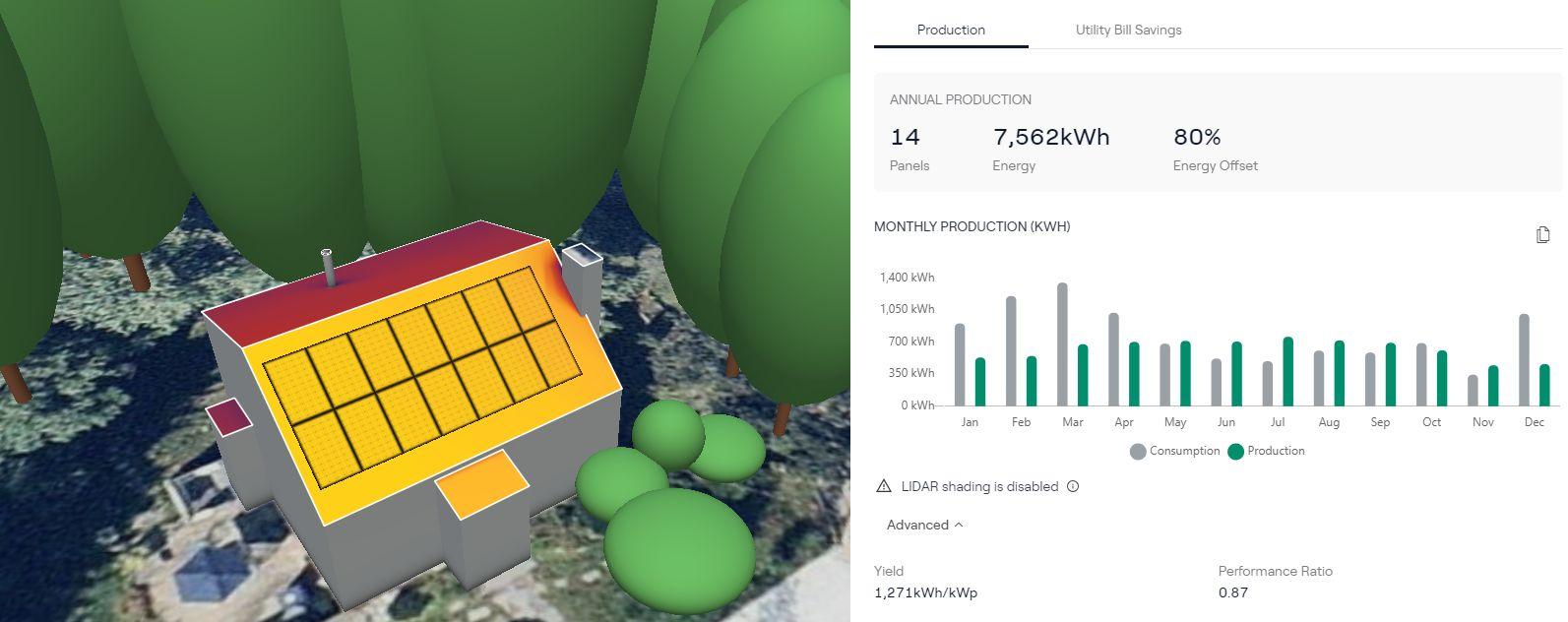
Consider this scenario: a homeowner consumes 9,400 kWh of electricity annually, and their solar system generates 7,562 kWh, providing an 80% offset. While some might be quick to dismiss this as insufficient, let’s examine the financial implications. 

partial offset aurora image.jpg
Calculation Assumptions:
  • Net electricity rate: 31 cents/kWh.
  • Annual rate escalation: 3%.
  • Neglecting max panel degradation of 0.5% or less per year due to natural deviation in weather cycles.
  • Net metering available at 1:1 ratio.
  • System cost of $3.75 per watt.
  • Cash purchase (for simplicity). 
Results: 
  • The solar array pays for itself (and then some) by year 5. 
  • By year 15, the homeowner enjoys savings exceeding $47,404. 
  • The remaining 20% of electricity costs amount to $11,522. 
  • After deducting system costs and uncovered bills, the homeowner still gains $21,263 by year 15 alone. 

 
Yes, you read that correctly! The partial-offset system has effectively covered the portion of electricity it couldn’t initially offset and will continue to do so well into the future. 
 
Now, let’s consider the alternative: continuing with conventional energy consumption. Over the same period, this approach would result in nearly $59,000 in electricity expenses, with costs continuing to escalate. This is assuming a 3% annual increase on electricity, (conservative compared to the real average increase: close to ~5% per year over the past decade). 
 
This is only looking at the first 15 years. With a 25-year warranty and estimated lifespan of over 30 years, the financial and environmental benefits become even more compelling. The contrast between the advantages of partial offset solar versus traditional energy consumption only grows wider over time.  

oceanview photo jump.jpg

Partial Offset, Full Impact

lupine love this house.jpg

Shifting our focus to the non-monetary impact, embracing partial offset solar plays a crucial role in broader community and global efforts to transition towards renewable energy. By adopting solar technology, homeowners become advocates for sustainable living and inspire others in their community to consider clean energy options. Collectively, widespread adoption of solar power can accelerate the shift away from fossil fuels and towards a cleaner, more sustainable energy future for all. 
 
Less than 100% offset is a great choice; it certainly beats ‘business as usual’ under the right circumstances. There’s ample opportunity on that small roof to make a significant positive impact on both your pockets and the planet. 
 
Imagery and production simulation are courtesy of Aurora Solar 

Share this page with friends

Filed Under: Under the Sun Blog Tagged With: Value of Solar

Achieving Home Energy Independence

March 25, 2024 by Ale Moreno

As concerns over climate disasters mount and energy costs rise, more homeowners are turning to renewable energy options to achieve energy independence and enhance their energy resilience. Energy independence means gaining independence from utility companies, rising energy costs, and fossil fuels. Homeowners want freedom from unpredictable energy costs, dependence on fossil fuels, and reliance on utility companies.   

Solar and home electrification improvements, such as heat pumps and Electric Vehicle charging, offer a pathway to increased independence and significant cost savings. While many solar-curious people perceive going solar as a purely environmental endeavor, homeowners nationwide go solar for the financial benefits and energy security that solar can offer in the face of volatile utility costs and increasing outages from climate-related disasters like storms and floods.   

Photos-116.jpg

Lastly, gaining home energy independence through solar helps alleviate stress on our local grids. This ultimately increases your entire neighborhood’s resiliency and dependence on dirty, fossil fuel-based energy sources. Investing in your own home’s energy also contributes to our whole country’s energy independence and furthers our efforts to transition to renewable energy-based systems.  Let’s dive into what energy independence through solar could mean for you.    

Why Energy Independence Matters   

Financial Benefits: 

Transitioning to an energy independent home results in long-term savings. You are no longer subject to fluctuating energy prices, offering peace of mind and energy price stability. This stability is especially relevant in places like Massachusetts, where residents pay 30% more in energy costs than the national average.   

Resilience: 

Homes with their own energy production systems depend less on external energy sources, meaning homeowners can rest easily during power outages or energy crises. A 2022 research article states, “One way to develop energy resilience is to integrate energy resilience products and practices into everyday life.” We’ll discuss some of these products and practices later in this post.   

Photos-137.jpg
Increased Home Value: 

There’s a growing trend in the housing market, especially in regions like New England, where homes with renewable energy infrastructure sell for higher prices. Potential buyers recognize the advantage of reduced energy bills and are often willing to pay a premium for it.   

 
Environmental Impact: 

Every step toward energy independence is a step toward reducing carbon emissions and our environmental footprint. According to an article published by researchers at Duke University, “Implementing energy efficiency improvements in the residential, commercial, and industrial sectors is one of the most effective tools to mitigate climate change because it allows for the same outcome to be produced by less inputted energy.”   

So, what does energy independence look like on a macro level? When considering the global perspective, household energy independence is not just an isolated trend; it’s part of a more significant shift towards decarbonization and energy security. ReVision’s co-founder, Phil Coupe, says that “adding solar to your home is one of the most patriotic things you can do.” Within this context, consider the United States’ contributions to global efforts towards making the clean, renewable energy transition.    

Energy Independence in the USA

As more homes produce their own energy, our country’s dependence on imported energy gets reduced. A recent article published in the Energies Journal confirms this: “An increase in households’ energy production helps to reduce the level of energy dependence in developed countries.”   

Photos-187.jpg

A research article published in the journal Environment: Science and Policy for Sustainable Development, further breaks down the relationship between household energy production and a country’s energy dependence, stating, “By changing the selection and use of household and motor vehicle technologies, households can reduce their energy consumption by nearly 30%—without waiting for new technologies, making major economic sacrifices, or losing a sense of well-being.” This decrease in home energy consumption would result in the overall US energy consumption dropping by 11%. Home energy independence will save money and help facilitate the United States’ green energy transition.  

How to Make Your Home Energy Independent 

Energy Efficiency:

Initiatives like home retrofits, using energy-efficient appliances, and focusing on design considerations can be the first steps towards achieving independence. Small, cost-effective measures can result in big savings. From utilizing CFL bulbs over incandescent ones to sealing structural gaps to ensure heat stays in the house, these changes can transform your home’s energy consumption. The International Energy Agency highlights that “energy savings can be achieved through relatively simple technological retrofits or behavioral changes.”    

Solar PV System: 
SolaratHome-58.jpg

Solar panels have become the quintessential tool for homeowners seeking energy independence. By converting sunlight directly into electricity, these panels enable you to produce your own energy, reducing reliance on the national grid. Over the years, solar technology improvements have resulted in more efficient panels at reduced prices.

The investment in solar panels often pays off within a few years, thanks to savings on electricity bills and potential government incentives or rebates. Solar panel installations can be tailored to your home’s energy needs and can be installed on rooftops or the ground. Community solar farms are another way to utilize solar energy, where you can purchase shares of a larger solar array to become a member. Energy produced by the solar farm is channeled into the grid and then allocated to you and other members based on the percentage owned.    


Battery Storage: 

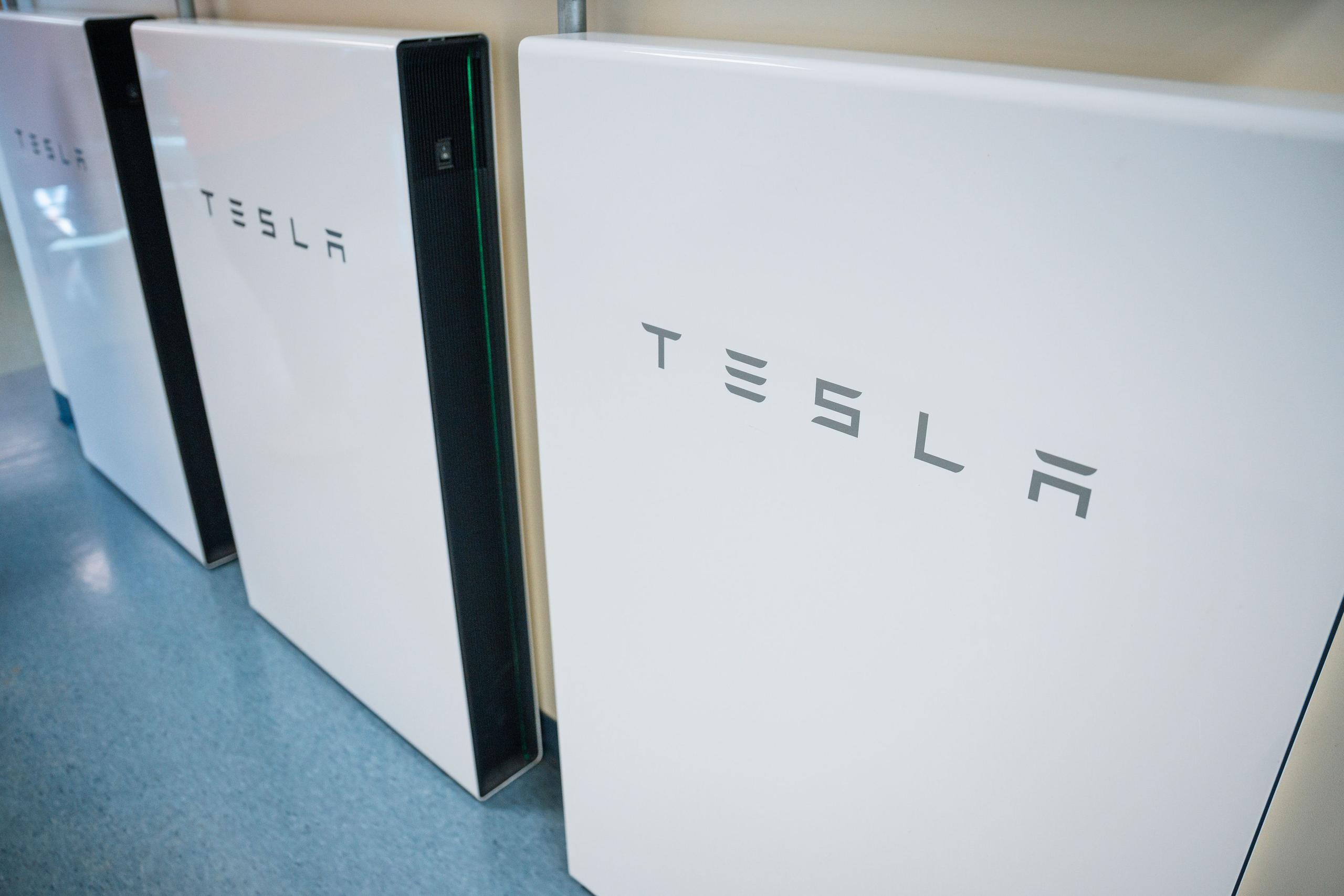
Alongside solar panels, battery storage can be an approach to achieving home energy independence. As the sun doesn’t always shine, homeowners need a way to store excess energy generated during peak sunlight hours. Modern battery storage solutions, like the Tesla Powerwall or equivalents, allow homeowners to store this energy and use it during night-time or cloudy days, ensuring a constant energy supply. Battery technology and incentives continues to advance, leading to higher storage capacities, faster charging times, and longer lifespan. 

Montville-2.jpg
EVs and Home Integration: 
Photos-184 (1).jpg

EVs and EV charging not only reduce reliance on fossil fuels but also support the grid’s shift away from coal and gas. Additionally, EVs are cost-effective, being cheaper to operate and maintain. In regions like New England, charging an EV is considerably less expensive than traditional gasoline, especially when powered by solar. By pairing EV charging with solar energy, you can harness local sun power for your travels, promoting savings and environmental responsibility.    


Air Source Heat Pumps: 
SolaratHome-16.jpg

A sustainable solution to home heating and cooling, air source heat pumps have garnered attention for their efficiency and reduced carbon footprint. Instead of creating heat, heat pumps move heat from one place to another using a tiny amount of electricity.

In colder months, they take warmth from the outdoors and bring it inside, and in warmer months, they do the reverse, acting as an air conditioner. This process can be up to three times more energy efficient than traditional heating methods, making heat pumps a great choice for those seeking energy independence and reduced greenhouse gas emissions.   

Home Energy Management Systems: 

Home Energy Management Systems (HEMS) optimize energy use in homes. These systems integrate with appliances, lighting, heating, and cooling units to offer real-time monitoring and control of energy consumption. With the help of machine learning and predictive algorithms, HEMS can make decisions on when to draw energy from the grid, the solar panels, or the battery, optimizing for cost and sustainability. They also offer insights and suggestions for further improving energy efficiency, such as suggesting the best times to run heavy appliances. A great example of a smart energy system is Sense.com. They offer in-home electrical panel monitoring, giving insight into the energy usage of different appliances.

Montville-21.jpg

Home energy independence is not just a matter of being eco-friendly; it also means having financial stability, resilience, and a positive impact on global sustainability goals. Renewable energy is constantly advancing and improving, making home energy independence more feasible and accessible. By pursuing this goal, we’re helping ourselves and the planet. 

Share this story with your community:

Filed Under: Under the Sun Blog Tagged With: by Ben Joslin, Value of Solar

Solar for Developers

January 23, 2024 by Ale Moreno

We talk a lot about the benefits of going solar for your home or business. (For example: Solar is a Resilient Investment Against Inflation and Solar Energy Increases the Value of Your Home.) But what if you own a building and don’t really use much electricity? This is a common scenario with property developers who often own large buildings – with ideal roofs for solar – and rent out the space. Folks in this situation may be interested in renewable energy, but have a hard time justifying the investment without large electricity bills. Luckily, you have options. Let’s explore.

  1. The Power Purchase Agreement (PPA)ReVision has worked hard to identify values-aligned investors who will take on the expenses and risk associated with developing a solar project. These impact investors own the panels. In turn, the building owners get solar installed at no cost to them and get to lock in a rate for their electricity for 20 years that is lower than what they would pay their electric utility! It’s a win-win. It’s also off the balance sheet, which can often be beneficial for the developer. Our PPAs come with a buy-out option; if ownership is a priority that can be arranged.
  2. Upfront purchase to increase borrowing limit. It’s well documented that adding solar to a building increases its property value. Purchasing the system outright is an upfront expense, but these systems pay for themselves within a few years. Additionally, the increase in property value also increases the amount of money a developer can borrow against this property, thus allowing them to pursue other projects.
  3. Lease payments. This option is less common, but still worth mentioning. If a developer owns a large roof that is otherwise not being used, they could be eligible to receive a lease payment from a solar investor who will pay for the use of the roof to create a solar farm. In this scenario, the solar investor owns and maintains the array while the building owner gets a monthly payment for use of the roof. This would be a much smaller payment compared to the savings from the other two options, but is still a reliable source of additional income. 

Frequently Asked Questions

What are our options for going solar on our roof?
 

The building owner typically pays for electricity in common areas. This might include things like emergency lighting, elevators, and security systems. Depending on the size of your roof, you might be able to fully offset this electric load with the solar array. If the system produces more electricity than you need, you may be eligible to sell the excess back to the electric utility through a process called net metering. (Please note: net metering credits work differently in different areas, so please talk to your solar specialist to see if this is an option for you.)

What if we don’t really have any electricity bills for the building?

Maybe the electricity you provide for the building is negligible. You can still install a system and set it up as a ‘full export’ system. In this scenario, the array produces solar normally and 100% of that energy generated is sent back to the grid. You as the building owner can get a locked in price per kilowatt hour generated so the array basically creates passive income for you.

Can my tenants use the solar on my roof? 

Yes! If you write a PPA into the tenant’s lease agreement, several co-benefits are put in motion. First, the tenant locks in a rate per kilowatt-hour of electricity from the solar array. The tenant will still receive a bill from the electric utility, but they will have reduced the amount of electricity they are buying from the grid! They get cleaner energy and save money. As the building owner, you can realize the tax benefits, own equipment that is revenue-generating, increase your property value, and create a new marketing point! This might sound like a lot of administrative work, but ReVision can help get you up and running; once set up, this plan takes a quarterly one-click report to get everything squared away.

Solar for Real Estate Developers: It Just Makes Sense

We have over 20 years of experience at ReVision Energy, and have seen how solar energy can have environmental, financial, and marketing benefits. With more tenants asking for cleaner sources of electricity, we see solarized buildings with higher occupancy rates and less turnover. If you have been thinking about increasing your sustainability, it is never too early to contact us to get a preliminary design. From securing LEED points, aligning with Passive House or Living Building Challenge standards, or simply enhancing your green building portfolio, it is advisable to bring solar specialists into the conversation sooner than later. 

Filed Under: Under the Sun Blog Tagged With: by Jen Stevenson Zepeda, Value of Solar

Going Solar in Massachusetts: Not Always Easy But Always Worth It

December 1, 2023 by Ale Moreno

Solar Is a Good Investment in Massachusetts 

by Solar Design Specialist Kel Monroe

The enormous push for renewable power and lower carbon footprints has encouraged many Massachusetts homeowners to consider solar panels on their roofs or in their backyards. We Bay Staters have a sense that we’re leading the charge, thanks to a mix of federal, state, municipal, and utility-based solar incentives. While it’s all very exciting, savvy observers can’t help but notice that it can be a long slog to that joyful moment when the system has fully paid for itself after such a large investment.  

There are factors that Massachusetts residents need to consider when calculating their solar payback period, which can often take longer than their solar neighbors in New Hampshire and Maine. Why are payback periods longer for some and, in the end, is it still worth it to go solar? 

Cait_Cote1_mailchimp.jpg

To be clear, we’re talking about ownership options, when systems are purchased outright in cash or via financing and solar loan options. This brings us to the first obstacle affecting solar payback periods: higher interest rates. With interest rates still relatively high at the end of 2023, many residents are tempted to wait until things cool down before taking the plunge on a higher interest rate loan product. 

But let’s say you’re paying in cash or have unlocked a favorable Home Equity Line of Credit (HELOC). Despite the numerous and long-lasting benefits of harnessing photons from our bountiful sun, people still find themselves facing longer payback periods compared to folks in other regions. There are several additional factors contributing to extended paybacks that shed light on why going solar in Massachusetts is a bit more challenging. 

Costs from Massachusetts Labor Regulations 

One significant hurdle homeowners face is the higher cost associated with installations. This is primarily due to the state’s stringent regulations which mandate a specific labor ratio on every solar installation project.

Cait_Resize3.jpg

Massachusetts requires licensed electricians to be present on every job site, and every other laborer must be a journeyperson (a worker formally in the process of gaining their electrician’s license). These ratios of fully licensed electricians to journeypersons result in higher labor costs that contribute to an overall increase in the installation expenses, some of which is included in a customer’s cost. 

The main consequence here is that the upfront investment required for solar construction work can be higher compared to many other states with less stringent regulations. Solar Champions in Massachusetts might have to accept slightly lengthier payback periods, meaning they may need to wait longer to recoup their initial investment through energy savings combined with federal and state incentives. While the long-term benefits of solar energy remain promising, this extra financial barrier can be a deterrent for some. 

Municipal Light Plants (Town-Owned Utilities) 

Another factor is the presence of municipalities with their own power companies, also referred to as Municipal Light Plants or MLPs. Each MLP has its own unique net metering policies. Net metering allows solar panel owners to sell excess energy back to the grid, offsetting their electricity costs.

net metering what happens to unused solar power.jpg

Unfortunately, some municipalities in Massachusetts have less favorable net metering policies, meaning homeowners may not receive as much credit for the excess energy they contribute to the grid, thereby lengthening the payback period.  

Despite these challenges, there’s a silver lining for Massachusetts residents considering solar. The key lies in making informed choices, both in terms of the installer and understanding the local policies. Homeowners should prioritize choosing companies with high ethics and a stellar reputation. Reputable installers with many years of experience will have strategies to navigate labor costs efficiently and ensure the installation process adheres to local regulations without inflating expenses unnecessarily.  

Finding the Right Solar Partner is Key 

It’s important to remember that even with a longer payback period, the financial benefits of solar remain substantial once you hit that sweet, sweet breakeven point. Homeowners should consider the potential energy savings, generous federal and state tax incentives, and the positive environmental impact when evaluating the viability of a potential solar installation. Even if you plan to move in a few years, the home value increase can be significant enough to allow a recoup of your investment when you sell. 

Cait_installer_resize.jpg

The road to solar energy in Massachusetts may be paved with challenges, but it’s a journey you can approach with optimism. By partnering with the right installer who provides honest projections and genuinely comprehends the local landscape, residents can reap the rewards of solar-powered living while making a sound financial investment.

ReVision Energy, who recently joined forces with Massachusetts solar company Sunbug, has worked with customers all over the Bay State to design systems that meet their budget and energy goals. We’ve seen it all and are great at navigating all the complicated intricacies that can challenge a solar project. We know going solar in Massachusetts might not always be easy, but it’s always worth it.  

Filed Under: Under the Sun Blog Tagged With: Value of Solar

Solar Energy Increases the Value of Your Home

July 10, 2023 by Ale Moreno

Updated December 2024

The benefits of installing a solar array include energy cost savings, a positive environmental impact, and renewable energy tax incentives and rebates. But did you know solar can also have a huge impact on your home value? In today’s highly competitive and expensive housing market, solar energy can add value and increase the sale price of a home. Buyers are more focused on sustainability and are increasingly prioritizing energy efficiency when evaluating a home purchase. Most buyers view solar as a major home improvement.

The Financial Advantages of Solar

Houses with solar – either rooftop or ground mounted – have a significant market premium. According to a study done by Zillow in 2019, houses with solar installations sell for an average of 4.1% more than those without solar. A more recent 2024 study based on Zillow data reveals that this premium has increased to 6.8%, showcasing the growing value buyers place on solar-equipped homes.

These benefits can increase depending on your location. A study done by national home appraising experts in Washington D.C. found that solar-powered houses in the D.C. area sold for 7.7% more than those without. Another recent study published in the Journal of European Real Estate Research further supports the added home value benefits, stating “valuation experts further validate the positive influence that on-site energy production has on property valuation.”

These diverse studies collectively paint a powerful picture of the economic advantages associated with solar installations. Let’s dig deeper into the reasons behind these price premiums.

Joe And Laurel's Solar Home In Harvard, MA

Energy Savings: A Marketing Tool

Energy savings can be used in marketing your home to potential buyers. A study done by The American Council for an Energy-Efficient Economy found that on average, houses that disclose their energy costs sell faster, and sell at a higher percentage than their original listing price. Julia Basset Schwerin, a Maine Green Broker, confirms that properly marketing your solar system is key to increasing its value.

Many homes with solar have little to no electricity costs, so the added benefit of disclosing a very low utility cost can absolutely help sell your house. This is particularly true in states like Massachusetts, where residents pay 25% more in electricity than the national average. Massachusetts also boasts some of the best incentive programs in the nation, like the SMART Program, and various other tax credits for residential solar adopters, making solar more appealing for potential home buyers.

Solar Outshines Other Renewable Infrastructures

New Gloucester Maine Solar Fischer

Ever wonder why other forms of renewable energy infrastructure don’t enjoy these same advantages? After all, wind turbines, high-efficiency HVAC systems, and other green home additions seem like viable options.

The answer is simple: none of these systems have been proven to consistently increase home value like solar installations. According to a meta-analysis study published in Energy Research & Social Science, solar installations are “the only energy infrastructure associated with consistently positive property value increases.” Solar power is a smart investment that pays off not only in energy savings but also increases your home’s worth.

In addition to reducing your carbon footprint, harnessing energy from the sun is a powerful investment for immediate utility bill savings and for your future home sale. 

Filed Under: Under the Sun Blog Tagged With: by Ben Joslin, Value of Solar

Solar Winter: Why Panels are More Efficient in Colder Temperatures

December 6, 2022 by Ale Moreno

Winter, especially in northern New England, is known for short days, decreased sunlight, and snowstorms. We frequently get asked whether solar works in the winter, and the answer is yes, solar panels produce energy in these dreary winter months. But did you know winter also means our solar panels are more efficient?

That’s right, photovoltaic (PV) cells are more efficient in colder temperatures, which is why New England’s annual solar resource is similar to that of Houston, Texas, even though Houston has longer days. 

Here’s why:

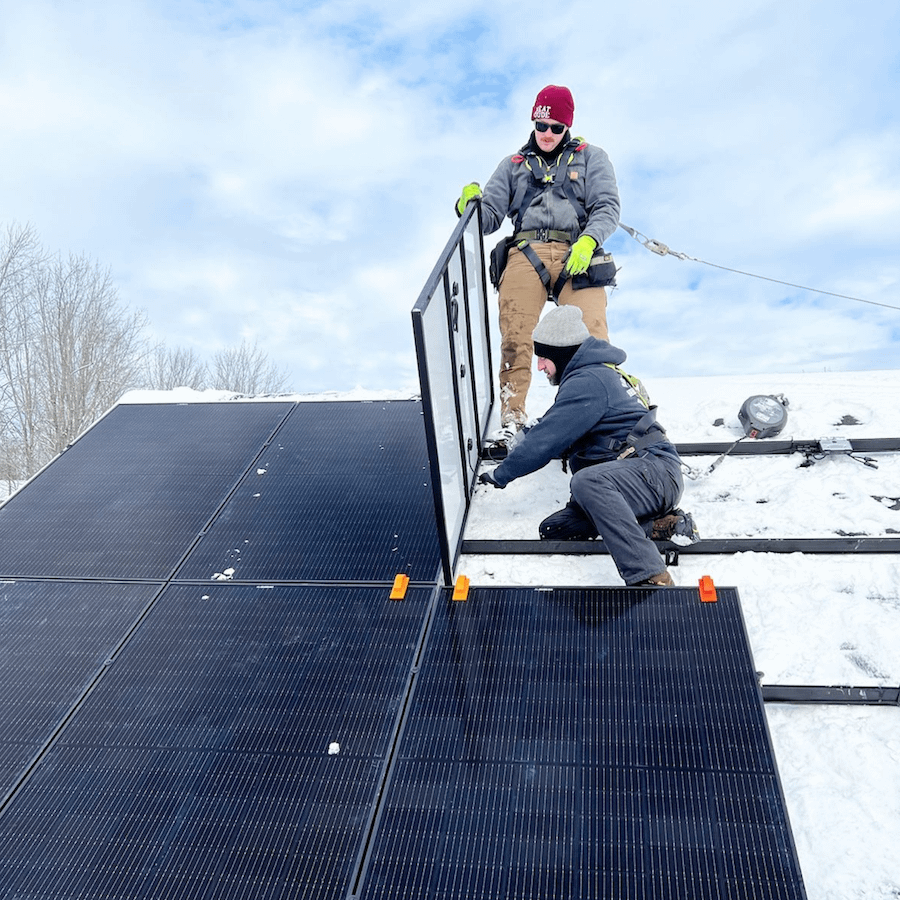
revision installers with solar panels in the winter

A photovoltaic solar panel creates energy when the sun’s light, known as irradiance, hits the cells, activating the electrons in the silicon. The faster the electrons move, the more energy is produced. A solar panel’s overall production depends on the difference between resting electrons and moving electrons.

In colder temperatures, electrons at rest have less energy, so when activated by the sun that difference is larger and the energy output is higher.

Solar is also more efficient when it is cold because there is less voltage drop in colder temperatures than in hotter ones. This is due to the fact that as temperatures drop, so does the resistance of the wire and as a result more power can be transmitted!

What about snow?

Although your array will not produce energy when covered in snow, the angle of the panels combined with the black color attracting heat means that the snow will slide off relatively quickly, like it does off a car windshield. (For this reason we do not recommend shoveling your solar panels). And once they’re clear the snow can actually help the energy output by reflecting sunlight back up off the snowy ground.

Everyone has experienced the blinding reflection when walking out into post-storm sunlight, and the solar panels thrive in that glare. In icy conditions or a light dusting of snow, the UV light is strong enough to penetrate through, so the array will still produce energy.

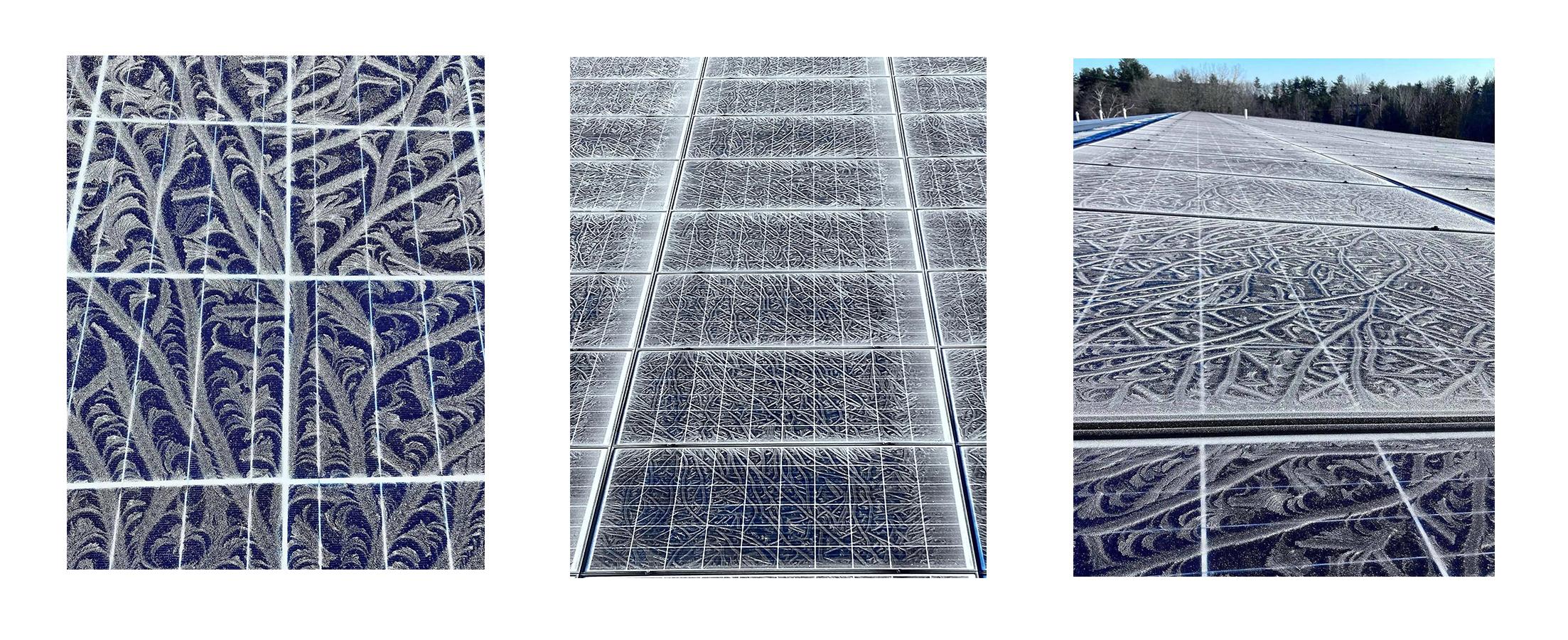
Eric on our service team shot these beautiful pictures last winter of ice-covered panels:

ice on solar panels

Ultimately the reduced daylight does mean that your solar array will produce
less energy in the winter, despite the increased efficiency of the panels. That’s why Net Metering is so important – most arrays in New England produce a surplus of energy during the spring and summer months, and those credits can be used during the shorter winter days. The end result, is a solar array that meets your electric needs over the course of a full year.

And don’t forget, if you pair it with battery back-up, your array will keep producing energy even during those snowstorms that cause power outage. 

Share with your friends.

Curious about solar? Email us: hello@revisionenergy.com

Filed Under: Under the Sun Blog Tagged With: Value of Solar

Keep Quiet and Cool with a Heat Pump this Summer, and Warm and Toasty this Winter

July 6, 2016 by Ale Moreno

Solar Powered Heat Pump System   Maine
Katherine Simmonds and son Pi keep cool while enjoying summer reads thanks to their heat pump!
 

Since the early 2000s, our clients have asked us how to use solar to heat their homes. For years, that solution involved literally trapping the sun’s heat using solar thermal collectors and transferring it to water, which could then circulate using a radiant loop. No more!

Today, efficient air source heat pumps are the system of choice for both new construction and existing homes to heat and cool, with or without solar.

An air source heat pump uses the same technology as a geothermal heat pump, but since it uses ambient air as its source (hence ‘air source’) it is a much simpler project, and hence, a smaller upfront investment. Heat pumps used to mainly be seen in the Mid-Atlantic or Southern States, but thanks to dramatic improvements in their low temperature performance, they are being rapidly adopted in the Northeast. The latest generation of heat pumps can provide heating to temps as low as -17 Fahrenheit.

The vast majority of the systems we install are ductless, consisting of an outside compressor/evaporator and an inside air handler. The units are connected using copper refrigerant line and we triple evacuate the lines with a deep vaccum and dry nitrogen purge, before charging them with an advanced refrigerant for the most efficient and reliable installation.

Based on current grid electric prices, it costs the equivalent of around $1.5/gallon of oil to heat with a heat pump, and using solar, as little as $1/gallon ! See more information about Heat Pumps here.

In cooling mode, a modern heat pump is roughly 1/2 the operating cost of a window unit air conditioner.

Customers Keep it Cool

A homeowner in Camden, Maine with solar PV on the roof and a heat pump to keep warm and cool! (lower left, tucked behind tree)

We asked some recent heat pump customers what they thought of their system – why they bought it and how it’s working out. Here’s what they had to say:

“We had 2 window units that could never make the house comfortable. My wife has a medical condition and is affected negatively from the heat. We were impressed that the heat pumps use LESS energy than the window units – and are much quieter. They are also much more attractive than the old window units.

We’ve also been impressed with the winter performance, we have used the units in temperatures as low as -5 degrees and they work great! We installed a large grid tied PV array and it appears we are making more power than expected and using fewer kilowatt-hours than we had in the past. If this is the case, we plan to run the heat pumps instead of the oil boiler in the winter.”

– Customer from Swanville

“We love, love, love our combination of solar and heat pumps! We live near the ocean so don’t really need the cooling, but the heating has been great. Three years ago, the island fuel company was filling our tank about once a month for a cost of $800. The following year, after installing two heat pumps, we had the oil tank filled only once. Our electric bill went up by about $100-$150 in the coldest months.”

– Customer on Peaks Island

“We had two very old window units in the living room and bedroom. They worked, but had no thermostats, and were large heavy things, awkward to install and remove, and loud. With our casement windows, we had to exchange the entire windows each spring/fall. We’d use them only a few hours at a time when we were actually in the room with them and awake.

The heat pump (we have just one) results in a much more comfortable environment – consistently cool and not just a blast of cold air. It’s certainly quieter than its predecessors and much more attractive. We let it run a lot more and the air is better throughout the house.”

– Customers in New London, New Hampshire

Got a heat pump? We’d love to hear from you too! On the next hot (or frigidly cold) day, please leave us a Facebook comment or Send us a tweet to let us know how your systems is performing.

Filed Under: Under the Sun Blog Tagged With: Value of Solar

sidebar

sidebar-alt

Subscribe to newsletter

Which newsletters would you like to receive?

Consent Enjoy the Sun(Required)
Consent(Required)
To provide the requested information, we need to store and process your personal data. By submitting this form, you agree to allow ReVision Energy to store and process your personal data for this purpose. Please see our privacy policy for more information.

  • Merch Store

Sitemap

  • Solutions
    • Homes
    • Commercial
    • Service
  • Our Work
    • Projects
  • About
    • Our People
    • Social Impact
    • Our Locations
    • Careers
  • For Customers
    • Support & Service
    • Be A Solar Champion
  • News & Events
    • Releases
    • Press
    • Under the Sun Blog
    • Events and Webinars
  • Our Partners
  • Resources

Follow Us

General Contact

Contact one of our branches for sales and non-service inquiries, or email us at hello@revisionenergy.com

Service

Need support for your existing system? Contact our Service Team:
Reach us at (207) 747-0076 or open a Support Ticket.

South Portland, ME

(207) 221-6342

Map & Directions 

Montville, ME

(207) 589-4171

Map & Directions 

Brentwood, NH

(603) 679-1777

Map & Directions 

Enfield, NH

(603) 632-1263

Map & Directions 

North Andover, MA

(978) 308-9041

Map & Directions 

Westfield, MA

(413) 884-1000

Map & Directions 

Copyright © 2026 ReVision Energy. All rights reserved.

Privacy Policy | Terms