

• Skip to primary navigation
  • Skip to main content
  • Skip to primary sidebar
Revision Logo Revision Logo
Solar Calculator Get Started
Get Started Solar Calculator
  • Solutions
    • Homes
    • Commercial
    • Service
  • Our Work
    • Projects
  • About
    • About
    • Our People
    • Social Impact
    • Our Locations
    • Careers
  • For Customers
    • Support & Service
    • Be A Solar Champion
  • News & Events
    • Releases
    • Press
    • Under the Sun Blog
    • Events and Webinars
  • Our Partners
  • Resources

Give us a call

Maine (207) 221-6342
New Hampshire (603) 632-1263
Massachusetts (413) 884-1000
Contact Us

by Jen Stevenson Zepeda

Auburndale Builders Create Award-Winning Net-Zero Homes

February 13, 2025 by Mauricio Pence

At ReVision Energy, we often work closely with builders, architects, and construction firms that are deeply involved in the worlds of building science, energy efficiencies, and sustainable housing. One of our partners is Auburndale Builders. Based out of Newton, Massachusetts, Auburndale has been in the energy efficient home construction and renovation industry since 2011.

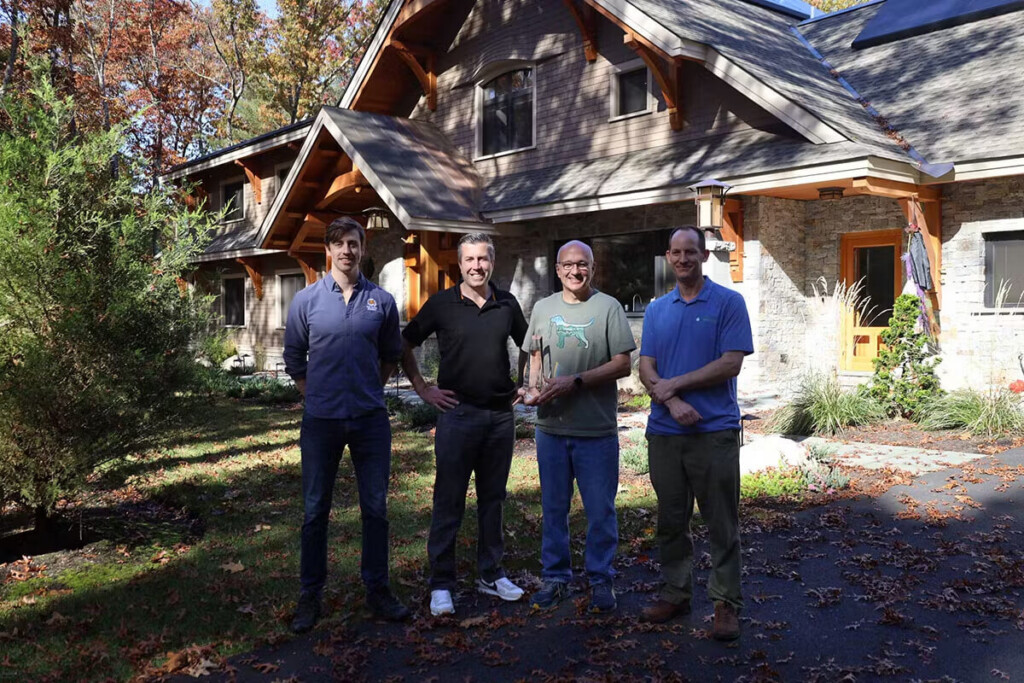
In 2023 ReVision worked with Auburndale to install a 32-kilowatt solar array and battery backup system on a high-performance home in Weston, MA, which went on to win BRAGB’s Gold Award for Best High Performance/ Energy Efficient Home. ReVision’s Solar Design Specialist Jen Stevenson Zepeda sat down with Auburndale’s owner and general manager Nick Falkoff to talk about this work.

Jen Stevenson Zepeda: This was a great year for Auburndale Builders. Congratulations on the BRAGB Gold Award for the Weston house! Could you tell us a little bit about this project?

Nick Falkoff: The clients decided on a Net Zero home in Weston; we were thrilled to work with them on creating this beautiful, efficient home with their architect. Apart from a natural gas fireplace, no fossil fuels are used at the home. All appliances and systems for this 8,000 sq ft home are powered by electricity and the home has a battery backup system for power outages. The grid-tied rooftop solar array generates enough power to power the home and electric vehicles. It was built to meet PassiveHouse standards.

Jen: How would you explain Net Zero Energy or Passive House buildings to your grandmother?

Nick: I think most people – grandmothers included – understand the idea of balancing inputs and outputs. By definition, a net-zero building puts as much electricity back into the grid as it draws from the grid. There are lots of other inputs to consider as part of that equation, but that’s the general idea.  A passive house uses solar orientation, super insulation, airtight construction, high performance windows, door and mechanical systems to reduce the heating and cooling energy loads by as much as 80% compared with a code-built home. If you stop there, you still are way ahead in terms of energy efficiency. However, once you have reduced your loads, you can meet the remaining 20% with solar electricity generation to get to a net-zero home.

Jen: Tell us a little about the state of Net Zero Energy buildings. Why is it important that we build these? What are some of the benefits? What are some of the challenges?

Nick: Net Zero Energy buildings are becoming more familiar to people as larger multi-family and municipal buildings are being built to meet Massachusetts’ progressive energy codes. These codes are part of a larger state decarbonization effort. As part of our work, we are seeing more questions about Net Zero retrofits, thanks to programs such as MassSave that incentivize the installation of insulation and energy efficient heat pumps in homes. I think climate resilience is one reason among many to build these types of homes, but the incremental additional cost to homeowners and the lack of education about Net Zero building among residential construction tradespeople are challenges that we are working to overcome.

Jen: What are some of the factors you are hearing that motivate folks to go this route?

Nick: For a number of people, the energy efficiency, health, and comfort that Net Zero homes provide are motivating factors. The increased cost of building a Net Zero home is offset over time by the savings in energy spending, which is appealing. Plus, these homes are more resilient during extreme weather events, like a cold snap or power outages and can be backed up with battery systems. Eventually the V2L Vehicle-to-Load-Technology that is built into many electric vehicles will allow the cars to power the homes during outages and separate house batteries will not be needed for backup power. 

Jen: How do you think about solar energy as part of the question of getting to zero?

Nick: Solar is a key component to getting to zero, as it’s the mini-power plant on the roof that transforms the sun’s energy into usable electricity. We can have a great building envelope that doesn’t require a lot of energy to heat and cool, but you’d still be reliant on the grid without solar to provide that offset.

Jen: Any last thoughts?

Nick: Thanks for your time and thoughtful questions. We’d love to talk more to anyone interested in Net Zero building. We work closely with the ReVision team to right-size the PV and battery back-up systems on our projects and value your expertise in these fields.


If you are in need of Auburndale’s handy work and expertise, please contact them here. And if you are curious about adding solar to your home or business, you can email ReVision Energy at hello@revisionenergy.com! 

Filed Under: Solar Champion Stories Tagged With: by Jen Stevenson Zepeda

Solar for Developers

January 23, 2024 by Ale Moreno

We talk a lot about the benefits of going solar for your home or business. (For example: Solar is a Resilient Investment Against Inflation and Solar Energy Increases the Value of Your Home.) But what if you own a building and don’t really use much electricity? This is a common scenario with property developers who often own large buildings – with ideal roofs for solar – and rent out the space. Folks in this situation may be interested in renewable energy, but have a hard time justifying the investment without large electricity bills. Luckily, you have options. Let’s explore.

  1. The Power Purchase Agreement (PPA)ReVision has worked hard to identify values-aligned investors who will take on the expenses and risk associated with developing a solar project. These impact investors own the panels. In turn, the building owners get solar installed at no cost to them and get to lock in a rate for their electricity for 20 years that is lower than what they would pay their electric utility! It’s a win-win. It’s also off the balance sheet, which can often be beneficial for the developer. Our PPAs come with a buy-out option; if ownership is a priority that can be arranged.
  2. Upfront purchase to increase borrowing limit. It’s well documented that adding solar to a building increases its property value. Purchasing the system outright is an upfront expense, but these systems pay for themselves within a few years. Additionally, the increase in property value also increases the amount of money a developer can borrow against this property, thus allowing them to pursue other projects.
  3. Lease payments. This option is less common, but still worth mentioning. If a developer owns a large roof that is otherwise not being used, they could be eligible to receive a lease payment from a solar investor who will pay for the use of the roof to create a solar farm. In this scenario, the solar investor owns and maintains the array while the building owner gets a monthly payment for use of the roof. This would be a much smaller payment compared to the savings from the other two options, but is still a reliable source of additional income. 

Frequently Asked Questions

What are our options for going solar on our roof?
 

The building owner typically pays for electricity in common areas. This might include things like emergency lighting, elevators, and security systems. Depending on the size of your roof, you might be able to fully offset this electric load with the solar array. If the system produces more electricity than you need, you may be eligible to sell the excess back to the electric utility through a process called net metering. (Please note: net metering credits work differently in different areas, so please talk to your solar specialist to see if this is an option for you.)

What if we don’t really have any electricity bills for the building?

Maybe the electricity you provide for the building is negligible. You can still install a system and set it up as a ‘full export’ system. In this scenario, the array produces solar normally and 100% of that energy generated is sent back to the grid. You as the building owner can get a locked in price per kilowatt hour generated so the array basically creates passive income for you.

Can my tenants use the solar on my roof? 

Yes! If you write a PPA into the tenant’s lease agreement, several co-benefits are put in motion. First, the tenant locks in a rate per kilowatt-hour of electricity from the solar array. The tenant will still receive a bill from the electric utility, but they will have reduced the amount of electricity they are buying from the grid! They get cleaner energy and save money. As the building owner, you can realize the tax benefits, own equipment that is revenue-generating, increase your property value, and create a new marketing point! This might sound like a lot of administrative work, but ReVision can help get you up and running; once set up, this plan takes a quarterly one-click report to get everything squared away.

Solar for Real Estate Developers: It Just Makes Sense

We have over 20 years of experience at ReVision Energy, and have seen how solar energy can have environmental, financial, and marketing benefits. With more tenants asking for cleaner sources of electricity, we see solarized buildings with higher occupancy rates and less turnover. If you have been thinking about increasing your sustainability, it is never too early to contact us to get a preliminary design. From securing LEED points, aligning with Passive House or Living Building Challenge standards, or simply enhancing your green building portfolio, it is advisable to bring solar specialists into the conversation sooner than later. 

Filed Under: Under the Sun Blog Tagged With: by Jen Stevenson Zepeda, Value of Solar

sidebar

sidebar-alt

Subscribe to newsletter

Which newsletters would you like to receive?

Consent Enjoy the Sun(Required)
Consent(Required)
To provide the requested information, we need to store and process your personal data. By submitting this form, you agree to allow ReVision Energy to store and process your personal data for this purpose. Please see our privacy policy for more information.

  • Merch Store

Sitemap

  • Solutions
    • Homes
    • Commercial
    • Service
  • Our Work
    • Projects
  • About
    • Our People
    • Social Impact
    • Our Locations
    • Careers
  • For Customers
    • Support & Service
    • Be A Solar Champion
  • News & Events
    • Releases
    • Press
    • Under the Sun Blog
    • Events and Webinars
  • Our Partners
  • Resources

Follow Us

General Contact

Contact one of our branches for sales and non-service inquiries, or email us at hello@revisionenergy.com

Service

Need support for your existing system? Contact our Service Team:
Reach us at (207) 747-0076 or open a Support Ticket.

South Portland, ME

(207) 221-6342

Map & Directions 

Montville, ME

(207) 589-4171

Map & Directions 

Brentwood, NH

(603) 679-1777

Map & Directions 

Enfield, NH

(603) 632-1263

Map & Directions 

North Andover, MA

(978) 308-9041

Map & Directions 

Westfield, MA

(413) 884-1000

Map & Directions 

Copyright © 2026 ReVision Energy. All rights reserved.

Privacy Policy | Terms