• Skip to primary navigation
  • Skip to main content
  • Skip to primary sidebar
Revision Logo Revision Logo
Solar Calculator Get Started
Get Started Solar Calculator
  • Solutions
    • Homes
    • Commercial
    • Service
  • Our Work
    • Projects
  • About
    • About
    • Our People
    • Social Impact
    • Our Locations
    • Careers
  • For Customers
    • Support & Service
    • Be A Solar Champion
  • News & Events
    • Releases
    • Press
    • Under the Sun Blog
    • Events and Webinars
  • Our Partners
  • Resources

Give us a call

Maine (207) 221-6342
New Hampshire (603) 632-1263
Massachusetts (413) 884-1000
Contact Us

Solar Industry News

Cumberland Unveils Town’s Solar Field

January 21, 2020 by Ale Moreno

Via News Center Maine :

Another Maine town is taking strides towards fighting climate change. On Tuesday, the town of Cumberland unveiled its new solar field. There are 1,248 panels on the field, which is built on top of the town’s capped landfill.

“Basically it was all municipal, solid waste, and it basically sat here dormant,” said Cumberland town manager Bill Shane. “We’re not allowed to let trees grow through it because of the trash underneath, so we have to mow it all the time, and when they approached us about using this for a solar field it made a ton of sense.”

Cumberland worked with ReVision Energy to construct the solar array. It is expected to produce 600,000 kilowatt hours of electricity each year.

The city of Cumberland purchased the equipment for the solar field through a power purchase agreement. That means the solar field came at no upfront cost to the town, and for the next six years, will only have to pay for the solar generated. In six years, the town will be able to officially purchase the field for $600,000.

ReVision Energy expects the town to see savings of roughly $20,000 in the first year. The solar field will be used to provide electricity to all of the town’s municipal buildings. Shane expects, in the next seven to eight years, to see savings of more than $100,000. Shane hopes that it will eventually lead to savings in the millions for the town.

Filed Under: Under the Sun Blog Tagged With: Solar Industry News

2022 Guide to Solar Tax Credit, Rebates, and Other Incentives

January 9, 2020 by Ale Moreno

Whether for home or business, solar in 2021 is the best deal EVER! Make it your resolution to reduce dependence on the traditional energy system and help the environment

Make it a Sunny New Year!

UPDATED: January 2022

There is bright news for both homeowners and businesses who are ready to make 2022 the year they finally go solar – the 26% federal tax credit was extended last year and will be accessible until the end of 2022! In addition to reduced solar panel prices and ever-increasing rates from sources of traditional electricity, this tax credit makes 2022 the best year to go solar.

In short:

  • The solar Investment Tax Credit (ITC) was scheduled to drop from 26% to 22% at the start of 2021. Instead, the credit remains available at 26% for both homeowners and businesses for solar projects constructed in the next two years .
  • An uncapped 26% federal tax credit on residential solar electric (PV) systems remains in effect through the end of 2022. 2023 will see a step-down to 22%, and the tax credit is currently scheduled to end completely in 2024 unless new legislation is passed.
  • In 2022, businesses can get a 26% federal investment tax credit in addition to state rebates.
  • Businesses can also take bonus depreciation on solar projects, accelerating the return on investment even more.

Read on for more specifics about each incentive.

Disclaimer: ReVision Energy provides this for educational use only, we are not tax professionals and are not offering tax advice. We recommend all solar customers to consult with tax counsel.

Federal Solar Tax Credits & Incentives

Residential 26% Federal Tax Credit

Lee Nh Solar Barth

The 26% federal tax credit is called the “Residential Renewable Energy Tax Credit” and was established by the federal Energy Policy Act of 2005. The 26% includes all cost of labor as well as equipment costs for the renewable energy system. The credit can also be carried forward to future tax years if you cannot take the full credit in the year the system was installed.

Furthermore, the IRS has issued guidance suggesting that battery storage systems, when charged with electricity from solar electric arrays, are eligible for the tax credit.

The credit was originally scheduled to be discontinued year-end, 2015, and then in 2020. However, it was extended again in December 2020 with the passing of the bipartisan stimulus bill in response to the COVID-19 pandemic. The bill introduced the following timetable:

  • 26% for systems placed in service after 12/31/2020 and before 01/01/2023
  • 22% for systems placed in service after 12/31/2022 and before 01/01/2024

More information:

  • A homeowner claims the 26% credit on IRS 5695, Residential Energy Credits (PDF)
  • Also, see DSIRE – Residential Renewable Energy Tax Credit

Business Energy Investment Tax Credit (ITC)

Hampton Ford Hyundai

Businesses, as well as homeowners, can benefit from a 26% tax credit on renewable energy systems, called the energy investment tax credit.

Similarly to the residential program, it was extended by Congress at the end of 2020 and faces a step-down at the end of 2022:

  • Through December 31, 2022 – 26%
  • Through December 31, 2023 – 22%
  • Through December 31, 2024, & All Future Years – 10%

Also similarly to the residential program, IRS tax guidance suggests that battery storage systems are eligible for this credit when the battery system is charged by a solar electric generation system.

More information:

MACRS + Bonus Depreciation

Ground Mounted Solar Array For A Business

Ground mounted solar array for a business

Under the federal tax code, renewable energy systems qualify for a 5-year Modified Accelerated Cost-Recovery System (MACRS) depreciation schedule.

The exact benefit of this depreciation is complicated and varies depending on your businesses’ tax rate, but typically it adds up to an additional 25% of a solar energy project’s cost being offset by reduced tax payments.

To further sweeten this incentive, The Tax Cuts and Jobs Act of 2017 increased bonus depreciation to 100% for qualified property acquired and placed in service after September 27, 2017, and before January 1, 2023.

Given the time value of money, this benefit helps make solar energy systems more accessible in the near-term by businesses that will be able to save significant fossil fuel energy costs over the life of the system.

More information:

Filed Under: Under the Sun Blog Tagged With: Solar Industry News

Schools, Towns and Nonprofits Unlock Powerful Savings with Solar PPAs

January 8, 2020 by Ale Moreno

Did you know that municipalities and nonprofits can go solar for no upfront cost through a Power Purchase Agreement? This arrangement allows nonprofits to save money with solar instead of paying extra for dirty power from the utility. Learn more from this helpful animation!

Filed Under: Under the Sun Blog Tagged With: Solar Industry News

W.S. Badger to Install One of the Region’s Largest Solar Arrays at its Headquarters in 2020

December 12, 2019 by Ale Moreno

ReVision Energy’s renewable energy projects are frequently featured in local and national newpapers, radio and television.

Via Benzinga :

W.S. Badger Co, an award-winning manufacturer of organic personal care products and a certified B Corp, today announced partnering with renewable energy company ReVision Energy to install onsite solar at its headquarters in Gilsum, New Hampshire in 2020.

This news comes as over 500 leading Certified B Corporations, including Badger, announced at the United Nations Climate Change Conference (COP25) in Madrid their commitment to accelerate the reduction of their greenhouse gas emissions to reach a 1.5 degree trajectory leading to net zero by the year 2030 – 20 years ahead of the 2050 targets set in the Paris Agreement.

“With this important commitment to solar, we’re building on our momentum to reduce our carbon footprint and do our part to solve the greatest challenge facing humankind today – climate change,” says Rebecca Hamilton, Co-CEO of W.S. Badger Company. “Signing this contract is just a first step in taking responsibility for our onsite energy use, and setting a goal of NZ 2030 (Scope 1 – 3) underscores our promise to take actionable steps right now that benefit our customers, employees, society, and the planet.”

Filed Under: Under the Sun Blog Tagged With: Solar Industry News

ReVision Breaking New Ground with Solar Farm

November 25, 2019 by Ale Moreno

At Good Will-Hinckley in Maine, ReVision crews are installing ground screws for a forthcoming solar farm to offset the municipal electric load for the Town of Freeport, ME.

Good Will-Hinckley President and Executive Director Robert Moody shared, “The land was just a hay field, unused since our beginning in 1889. This is a great use of the property versus it sitting there doing nothing. Now it’s going to be reducing the carbon footprint in the state.”

Under Maine’s new solar policy, Good Will-Hinckley is incentivized to host the solar farm on its property by receiving lease payments from the developer, and the Town of Freeport benefits by purchasing clean, renewable solar electricity at a rate lower than what it costs for brown utility power from the grid. Coincidentally, Good Will-Hinckley is also the site of the first solar array to be built in Maine (by ReVision) under the financing mechanism known as a Power Purchase Agreement .

Filed Under: Under the Sun Blog Tagged With: Solar Industry News

Bucksport Completes Second Municipal Solar Project with Help of Solar Impact Fund

October 31, 2019 by Ale Moreno

The Town of Bucksport, Maine has a new solar array to accompany one installed on their Public Works Department last year – combining to generate a 40-year savings of well over $1.5 million for the town. The latest array is located at their Wastewater Treatment Facility, and will reduce the treatment plant’s electric bill by nearly 50%. Bucksport taxpayers are excited to benefit even further from their abundant solar resource.

Such savings are available to other municipalities, schools, and other nonprofits with the help of ReVision’s ever-growing Solar Impact Funds. With a Power Purchase Agreement, nonprofits can go solar at no upfront cost, and lock in a lower rate for electricity long-term than they would receive from the utility grid. Know of a nonprofit that’s ready to go solar? Put them in touch for a free site visit, or arrange your one of your own!

Filed Under: Under the Sun Blog Tagged With: Solar Industry News

ReVision Energy Launches ‘Solar Up Andovers’ Neighborhood Discount Program

October 4, 2019 by Ale Moreno

ReVision Energy’s North Andover, MA branch is launching a discount program for customers in their backyard!

ReVision Energy’s North Andover location has launched a neighborhood discount program called Solar U p Andovers ! Good for contracts signed from Oct 15, 2019 – Feb 29, 2020 .

The neighborhood discount is 5% off any solar energy system, as well as any related technology such as heat pumps, heat pump water heaters, EV chargers and batteries. All homes and businesses based in North Andover, MA and Andover, MA are eligible for this discount, which on average amounts to $1,500 – $3,000, depending on the size of the project.

“ R eVision Energy is deeply committed to the Greater Andover area and we’re using this neighborhood discount program to accelerate solar deployment to the community in our back yard,” said James Manzer, branch manager of ReVision’s North Andover, MA location.

As part of this program, ReVision will be doing several public events talking about solar and other clean energy options, including batteries, which, for National Grid customers, are eligible for substantial incentives as part of the state’s Demand Response program.

“We are all very excited to be able to offer this program to our community where we have chosen to grow our roots. North Andover and Andover have been an amazing ly warm and welcoming communit ies and we are excited to thank th e se communit ies with this benefit as they transition away from fossil fuels.” said Brittany Angelo, Outreach Manager for the North Andover, MA location. “We hope we get to meet more of the community through this neighborhood campaign. Please come out and meet us at the next event!”

Upcoming events: National Solar Tour – Saturday Oct 5th, 10-2pm, 191 Barker St, North Andover, MA. Trustee’s Fall Foliage Celebration – Saturday Oct 19th, 10-3pm, Stevens-Coolidge Place, North Andover, MA – A Trustees Property. Boos and Brews: Adult Pumpkin Trail – Thursday Oct 24th & Friday Oct 25th, 6-9pm, Stevens-Coolidge Place, North Andover, MA – A Trustees Property. Stay tuned for details on a Solar & Battery 101 at our Office, North Andover, MA. Winterlights – Thursday Nov 21st thru Sunday Dec 29th, 5-8pm, Stevens-Coolidge Place, North Andover, MA – A Trustees Property.

Sign Up for Solar Up Andovers

  • An essential step in designing a solar array is an evaluation of your electric needs. Uploading all pages of a recent electric bill will help jumpstart the process and lead to a more meaningful conversation when we connect with you!

    Accepted file types: jpg, png, pdf, Max. file size: 50 MB.

  • Is This Address Correct?

    Move this pin to where you’d like your solar to go!

  • If you selected Municipal/Nonprofit, please chose your industry:
  • Hidden
  • This field is for validation purposes and should be left unchanged.

Filed Under: Under the Sun Blog Tagged With: Solar Industry News

Dover School Achieves Solar Milestone, Array to Save Taxpayers Over $4 Million

August 27, 2019 by Ale Moreno

G7dhg048f36b4945445c99a4b584977c

912-kilowatt rooftop solar array.

Dover, N.H. – ReVision Energy has completed the installation of the largest rooftop solar array in company history. The project at the Dover High School and Career Technical Center includes 2,581 solar panels, increasing the state’s solar capacity by 1.5% and saving Dover taxpayers more than $4 million long-term at no upfront cost. The project was unanimously approved by the Dover City Council last year. A public solar ribbon-cutting to celebrate the completion of the project is scheduled on September 19th.

The solar array has a useful lifespan of 40 years and will generate over 1,000 megawatt-hours of electricity each year, offsetting roughly 40% of the school’s electric load. The solar power generated by the array is equivalent to offsetting 558 tons of carbon pollution each year or the annual electricity use of 88 homes or the carbon sequestered by 600 acres of forests.

The 912-kilowatt array was financed through a Power Purchase Agreement (PPA) which enables the city to purchase electricity at below-market rates and includes a purchase option that becomes available in year 10 of the agreement. Exercising the purchase option would enable the city to acquire the array at a significant discount and produce free solar energy for decades to come.

Investor partner Kenyon Energy owns the school array and will sell the electricity to the city at a negotiated rate. PPAs enable nonprofits, municipalities, and schools that are precluded from accessing available solar incentives to transition to clean energy at no upfront cost. The PPA gives the city the ability to leverage the economic benefits of solar power while affording the investor partner the opportunity to make community investments that align with its core values of creating positive change in the world.

Ongoing maintenance and operations of the project will be managed by Bay4 Energy, one of the country’s leading solar service companies providing a comprehensive suite of energy and asset performance management services.

The Renewable Energy Credits (RECs) generated by the array will be sold by Kenyon Energy into environmental compliance markets for the term of the PPA. RECs are market-based mechanisms that represent the environmental benefits of solar power generation. A REC is produced when an array generates one megawatt-hour of solar electricity.

ReVision Energy’s agreement with the City of Dover includes an educational initiative aimed at teaching students how solar energy works and exposing students to the various functions involved in the engineering, electrical, and marketing aspects of the project.

According to Dover Energy Commission member Zachary Koehler, “This project has the potential to ignite the imaginations of current and future students. I am hopeful that this array will intrigue students to learn more about this technology and entice them to utilize the educational possibilities they have at Dover High School and the Career Technical Center.”

Koehler added, “This has the potential to stimulate a passion for engineering and development of this technology in their future endeavors, be it in furthering education or career opportunities. When this happens, our students can be the ones who bring our community, our state, and our country closer to the clean energy future that we so desperately need.”

The City of Dover also partnered with ReVision Energy on the installation of rooftop solar arrays at the Children’s Museum of New Hampshire and adjacent Dover Indoor Pool. ReVision Energy donated 103 solar panels for the installation, part of a 318-panel solar array at the museum and pool which share a common electricity meter. The rooftop projects installed on the museum and indoor pool are owned by ReVision Solar Impact Partners (RSIPs).

Under the terms of the RSIP program, impact investors provide capital to build solar projects. Investors earn a modest rate of return through payments made for solar generation, tax incentives, and other project benefits while solar installers benefit from a steady pipeline of work. The entity entering into the agreement receives a reduced electric bill. ReVision Energy continues to seek out impact partners for future projects. Learn more about Solar Impact.

ABOUT REVISION ENERGY

ReVision Energy is a local, employee-owned company on a mission to accelerate New England’s clean energy transition from fossil fuels to solar energy. As a Certified B Corporation, ReVision is part of a global movement using business as a force for good to solve social and environmental issues.

ReVision Energy consistently ranks among the best solar companies. The company has been recognized as the #1 Rooftop Installer in New England from 2017 through 2019 by Solar Power World Magazine and a 2018 “Business of the Year” by Business NH Magazine.

ABOUT KENYON ENERGY

Kenyon Energy is a leading developer, owner , and operator of solar energy projects in the United States. Kenyon Energy takes great pride in providing excellent customer service, while developing cost-effective, turnkey, and creative solar energy solutions for a diverse set of customers, including utilities, municipalities, schools and universities, federal and state government facilities, small and large industrial facilities, and Fortune 500 companies. For more information, visit kenyonenergy.com.

ABOUT BAY4 ENERGY

Bay4 Energy is a leading independent renewable energy service organization that provides a comprehensive suite of energy and asset performance management services designed to keep owners, investors, and operators in touch with their renewable assets while delivering optimized energy production and financial returns. Bay4 is trusted by its partners to manage every aspect of a project or portfolio, including asset management, operations and maintenance, independent engineering reviews, monitoring, and more. For more information, visit bay4.com.

Filed Under: Under the Sun Blog Tagged With: Solar Industry News

Hanover, Lebanon Celebrate Solar in Push Toward Renewable Energy

August 23, 2019 by Ale Moreno

img-9769.jpg

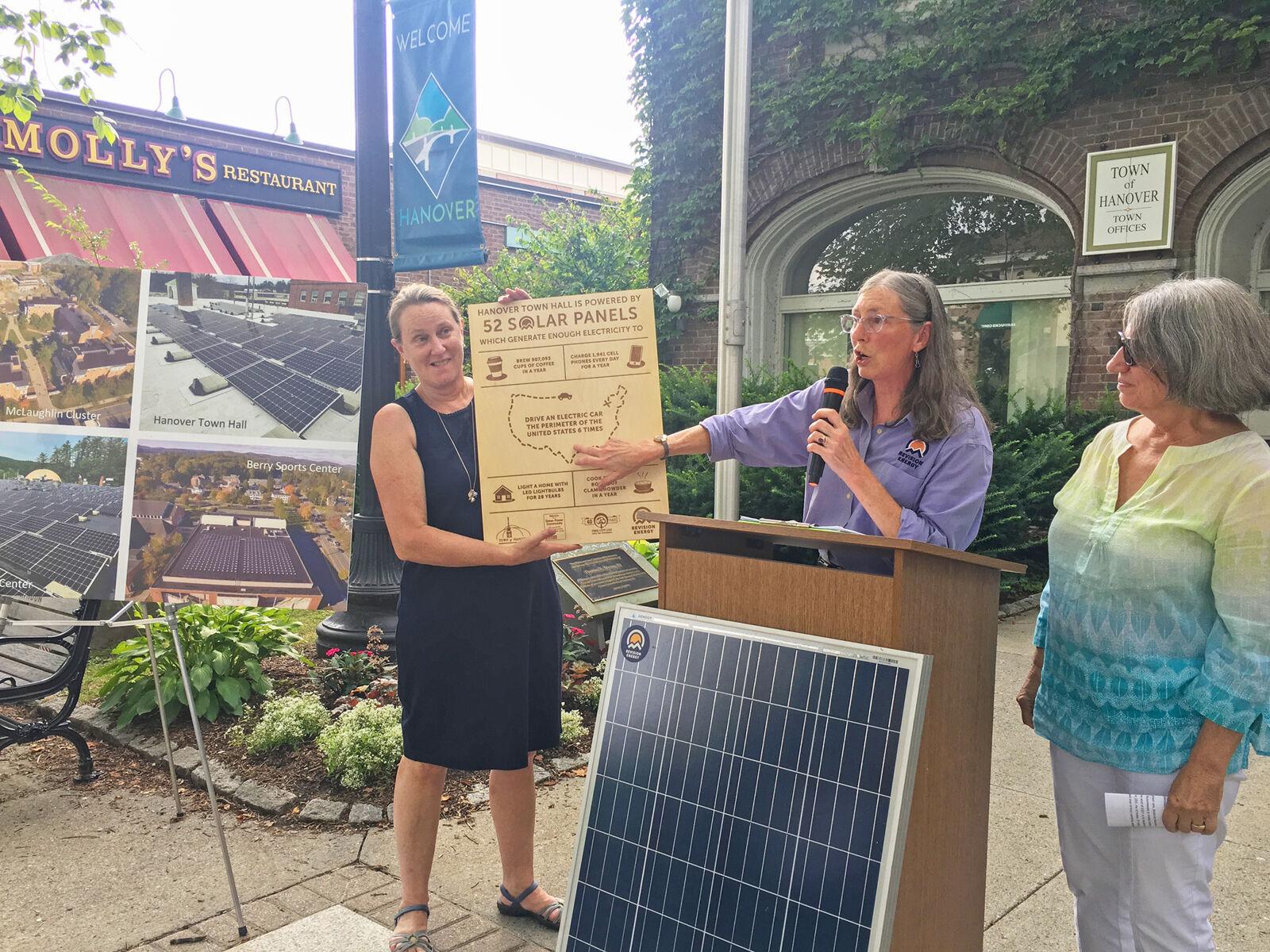
Via Valley News : On Thursday, August 22nd, a ribbon-cutting ceremony was held in Hanover to celebrate recently-installed solar arrays on the Town Hall and water treatment plant:

Combined, the town expects the 270 grid-tied panels to generate more than 85 kilowatts of electricity a year, toward its goal of running on 100% renewable energy by 2050.

“The one on Town Hall has been up and running since May,” Town Manager Julia Griffin said Wednesday of the building’s 52-panel array. “The one on the treatment plant just came online in the last two weeks.”

img-9765.jpg

The ribbon-cutting for Hanover’s rooftop installations comes a week after Lebanon and ReVision formalized a ” power-purchase agreement .” The pact calls for ReVision to build solar arrays at eight city properties and for Lebanon to buy the power generated for five years, at the end of which it would have the option to buy the infrastructure.

With a goal of generating almost 820 kilowatts a year across all eight properties, the project is expected to begin construction in the next couple of weeks at City Hall; at the public-works administrative offices and maintenance buildings east of downtown; at the police station on Poverty Lane; and at the Kilton Library, the city landfill and recycling center, and the wastewater treatment plant in West Lebanon.

Hanover recently signed a letter of intent for ReVision to erect another 2,000 panels on the ground at the town reservoir, which ReVision would own under an arrangement similar to Lebanon’s for the first five years.

That installation, which ReVision outreach chief Christina Zlotnick said is expected by year’s end, would generate another 700 kilowatts, effectively offsetting about 41 tons of carbon pollution a year.

On the residential side of Hanover’s energy-conservation efforts, Griffin said that since the spring, the town has connected solar installers with 54 homeowners for site visits, under its Solarize 2.0 project.

“The federal tax deduction for installing solar goes down on Jan. 1,” Griffin said. “We hope that will be an incentive for some to sign contracts.”

Filed Under: Under the Sun Blog Tagged With: Solar Industry News

Watch: What Maine’s New Solar Bill Means for Municipalities

July 22, 2019 by Ale Moreno

Solar energy offers municipalities the opportunity to reduce long-term energy costs and carbon pollution – now with the passage of Maine’s new solar bill (LD 1711), solar is more financially attractive than ever.

ReVision’s Fortunat Mueller had a conversation about what this new bill entails with Julie Rosenbach of the City of South Portland – watch here to learn about its implications for municipalities, and how municipalities of all sizes can benefit from integrating solar into their energy planning.

Filed Under: Under the Sun Blog Tagged With: Solar Industry News

Community Project to Help Local Farmers Harvest the Sun

July 15, 2019 by Ale Moreno

Via Sentinel Source :

Farmers in the Monadnock Region could soon harness the power of the sun – for more than growing crops.

Plans are in the works for a community-supported solar energy project on Sun Moon Farm in Rindge. The 95-kilowatt array would produce far more power than the farm needs, so the idea is to have other farmers in the region buy in. Each farmer would receive credit for a share of the electricity produced there, reducing his or her energy costs.

“It fits in well with our mission of conservation of natural resources, but improving the viability of farm businesses as well,” said Amanda Littleton, district manager of the Cheshire County Conservation District, one of the entities involved. “And so we just saw this as a really great opportunity to help farms be more profitable.”

Filed Under: Under the Sun Blog Tagged With: Solar Industry News

2019 Solar Bills Fix Net Metering in Maine & Expand Market

July 2, 2019 by Ale Moreno

We’ve been pushing for better solar policy in Maine for more than 5 years! This photo from the archives shows ReVision co-founder Phil Coupe testifying against the “Standby Fee” CMP proposed to tax solar customers back in 2014. Now, the relentless attacks on solar have been countered with policy that moves us forward instead.

A recap of the major legislative victories for Maine solar policy in 2019:

After 8 years of hovering on pause or going backwards, 2019 marks the year Maine’s solar policy made strong forward progress. Here’s a quick rundown of the legislative victories and what they mean for all Mainers.

LD91 – Eliminate Gross Metering

Sponsored by Rep. Seth Berry (D) of Bowdoinham, LD91 was the first, and most rapid, victory, undoing the LePage-era “Gross Metering,” which penalized homeowners for going solar. Covered in more detail at: Death to Gross Metering FAQ

LD1711: Transforms Solar Market for Commercial, Municipal, Nonprofits, and Community Solar

Sponsored by Sen. Dana Dow (R) of Waldoboro, LD1711 passed with overwhelming bipartisan support in the senate and strong support in the House, and was signed by Gov Mills on June 26th. Many of the ideas for this bill were part of comprehensive solar policy we’ve worked on with a broad coalition of solar allies since 2015 , with the goal of harnessing solar’s unique value to the grid and broadening the set of people who can benefit from solar development.

This bill is a game-changer for commercial, nonprofit, municipal, and community solar:

  1. Modernizes Net Metering by eliminating a 10 meter cap on community shared solar projects, raises project size limit to 5,000 kilowatts (enabling economies of scale), and makes it explicit that third-party ownership (e.g. non profit PPAs, solar leases) are allowed under net metering. This effectively revives the opportunity for the community solar farm market in Maine, which went dormant during the LePage years.
  2. Creates a net metering program specifically for Commercial and Institutional (C&I) customers.C&I projects have often been difficult to make work under conventional net metering, because many of these customers pay a substantial portion of their electric bill based on ‘demand’ charges, a fixed fee based on the highest 15 minute usage of any given month, rather than on a volumetric basis (per kwhr). Conventional net metering works by compensating 1:1 for kilowatt-hours generated offsetting kilowatt-hours consumed. Since the cost these businesses pay much less per kilowatt-hour than smaller customers (who don’t pay demand rates and instead pay a higher T&D rate), the economics of net metered solar projects have often been challenging for these medium sized commercial and institutional/municipal customers.Under the new legislation, these C&I customers will receive a compensation rate for exported solar that will be much closer to what small commercial and residential customers receive under retail net metering. The result is that project economics should improve by 20-26% for many commercial projects, dropping a 10+ year project payback to a 5-6 year payback in many cases. Leveling the playing field for these medium commercial scale customers means that many more Maine businesses (and towns and schools and other non profits) can now invest in cost effective solar projects to offset their electrical load.
     
  3. The legislation directs the PUC to enter into long term contracts for large C&I (up to 5 MW) and large Community solar projects. The idea is similar in design to the procurement designed by the OPA for LD1649 several years ago and builds on some of the experience of the industry with procurement programs to our south (like SMART in MA).The long term contract rates are initially set by a competitive procurement to be held in early to mid 2020. Rates for projects after the initial auction are set through a series of declining blocks over the next several years. In short, the competitive procurements and long term contracts will result in the development of solar projects with large economies of scale that can offer broad social and economic benefits for both residential and commercial customers. In addition, the large community solar projects have the potential to significantly help low and moderate income Mainers participate and benefit from the clean energy transition, which has been a central policy goal of ours for a long time.

Some portions of LD1711, including the net metering updates and C&I net metering program, will go into effect relatively quickly this fall, while others (the procurements and long term contracts) will require additional rule making by the PUC and so will mostly affect projects being built in late 2020 or beyond.

LD1430 – Fixes Taxation Issues Around Solar

While it received less public attention than some of the other policy changes, LD1430 (sponsored by Rep. Ryan Tipping (D) of Orono) is incredibly important in that it fixes property tax issues with solar projects which have caused grief for existing customers and acted as a drag on residential, community and commercial solar projects across the state for the last few years.

The issue had been that municipalities did not have clear guidance on how to handle property taxation for solar projects, and in the absence of such guidance, some municipalities had applied property tax assessments at levels that were punitive and significantly undermine the value proposition for customers.. This issue and uncertainty has been a particular pain point for some of our customers in affected communities including a number of community solar farms, and we are proud to have worked with stakeholders inside and outside the Statehouse to help make sure the issue was addressed in this session.

With LD1430, Maine joins the majority of New England states in enacting a statewide property tax exemption for residential and commercial solar property (except for utility scale solar projects). It also directs Maine Revenue to develop standardized methods for solar valuation to create a predictable and consistent climate for these investments.

LD1494 – Modernizes Maine’s RPS and Pushes Toward 100% Renewables

This bill (sponsored by Sen. Eloise Vitelli (D) of Sagadahoc, a longstanding solar champion) modernizes Maine’s Renewable Portfolio Standard (RPS), clarifying definitions about what constitutes ‘renewable energy’ and setting ambitious goals of achieving 80% renewable generation by 2030 and 100% by 2050. This policy matches the renewable energy targets Gov Mills outlined earlier in the year and that she talked about at her inauguration.

The RPS is a mechanism that requires power companies to source a certain amount of their power from renewable sources each year. There is a lot of technical nuance about types (Classes) of RPS and which types of power generation qualifies under which Class, but in short the purpose of these policies is to encourage grid-scale deployment of renewables and provides a mechanism to do so.

Something that has been problematic about Maine’s RPS is that much of the current RPS is filled by existing biomass power plants, which, while important, doesn’t create the appropriate incentive to develop new, indigenous energy generation from wind and solar. This has had the effect of encouraging more natural gas deployment in Maine than we otherwise would have had.

Maine’s RPS has lagged behind other New England states, and with the passage of this new legislation, we are now returning to a position of leading our region. Over time, this policy is expected to lead to the development of a whopping an estimated 500 MW of new solar and 200 MW of new wind, and the creation of nearly 2,000 jobs over the next 10 years.

More on the implications of the RPS – https://www.nrcm.org/wp-content/uploads/2019/05/MERPSAnalysisFacts.pdf

LD1519: Allows for Creation of Benefit Corporations in Maine

Not directly solar-related, but as a Certified B Corp we laud this bill (sponsored by Sen. Erin Herbig (D) of Belfast), which makes Maine the 30th state to allow for the creation of Benefit Corporations, and highlights the growing movement toward businesses with a social purpose and conscious capitalism.

Certified B Corps and Benefit Corporations are two different but related concepts and a company can be one or the other or both. A Benefit Corporation is a specific legal business structure whereby the social benefit purpose of the business is expressly incorporated into its founding documents. Certified B Corp, on the other hand, is a rigorous, independent, voluntary, third party evaluation and certification of a company’s overall business practices and social purpose. ReVision Energy has proudly been a Certified B Corporation since 2015 and we are excited to investigate conversion to a Benefit Corporation now that that option is available in Maine.

LD1282 – Solar on Schools

The ambitiously titled “Green New Deal” legislation (sponsored by Rep. Chloe Maxmin (D) of Nobleboro) includes a provision whereby solar should be installed on every new school built in Maine. Today’s students are tomorrow’s leaders – this is a solid idea we can get behind!

The bill also includes provisions on workforce development for the green jobs of tomorrow. With the development of our in house electrical apprentice training program, ReVision Energy Technical Center, ReVision has been a regional leader in new economy workforce development and we look forward to working with state leaders, labor and the community college system to deepen that effort in the future.

Revision Energy Rallying For Solar At Statehouse In Augusta

ReVision Energy staffers rally for solar at the Capitol Building in Augusta, ME in 2016.

It was an extremely busy legislative session in Augusta on topics of energy as well as a broad host of other issues. We’re very pleased with the outcome and so incredibly grateful for the hard work of our community of solar champions. It would be impossible to name all the individuals who worked tirelessly for these outcomes but they include a broad bipartisan coalition of lawmakers and legislative leadership (special shout-out to Sen. David Woodsome (R) of Waterboro, who as Chair of the Energy, Utilities & Technology Committee has been a consistent, bipartisan voice for common sense solar policy), environmental advocates, and many passionate and dedicated individual environmental and solar champions who share our belief that Maine can, and should, build its future economy on renewable energy. We thank you all for your efforts and are so grateful to have the opportunity to do this important work together with you.

The accomplishments and progress we made in this legislative session will lead to the creation of hundreds of new solar jobs, an enormous reduction in Maine’s carbon pollution, and will begin to point Maine in the direction of a promising and prosperous clean energy future. Though Maine is still behind the pack in terms of solar adoption, we’re finally pointed in the right direction, and so expect to see us move up the national leaderboard over the next few years. Onward!

Filed Under: Under the Sun Blog Tagged With: Solar Industry News

  • « Go to Previous Page
  • Page 1
  • Page 2
  • Page 3
  • Page 4
  • Page 5
  • Page 6
  • Interim pages omitted …
  • Page 23
  • Go to Next Page »

sidebar

sidebar-alt

Subscribe to newsletter

Which newsletters would you like to receive?

Consent Enjoy the Sun(Required)
Consent(Required)
To provide the requested information, we need to store and process your personal data. By submitting this form, you agree to allow ReVision Energy to store and process your personal data for this purpose. Please see our privacy policy for more information.

  • Merch Store

Sitemap

  • Solutions
    • Homes
    • Commercial
    • Service
  • Our Work
    • Projects
  • About
    • Our People
    • Social Impact
    • Our Locations
    • Careers
  • For Customers
    • Support & Service
    • Be A Solar Champion
  • News & Events
    • Releases
    • Press
    • Under the Sun Blog
    • Events and Webinars
  • Our Partners
  • Resources

Follow Us

General Contact

Contact one of our branches for sales and non-service inquiries, or email us at hello@revisionenergy.com

Service

Need support for your existing system? Contact our Service Team:
Reach us at (207) 747-0076 or open a Support Ticket.

South Portland, ME

(207) 221-6342

Map & Directions 

Montville, ME

(207) 589-4171

Map & Directions 

Brentwood, NH

(603) 679-1777

Map & Directions 

Enfield, NH

(603) 632-1263

Map & Directions 

North Andover, MA

(978) 308-9041

Map & Directions 

Westfield, MA

(413) 884-1000

Map & Directions 

Copyright © 2026 ReVision Energy. All rights reserved.

Privacy Policy | Terms