• Skip to primary navigation
  • Skip to main content
  • Skip to primary sidebar
Revision Logo Revision Logo
Solar Calculator Get Started
Get Started Solar Calculator
  • Solutions
    • Homes
    • Commercial
    • Service
  • Our Work
    • Projects
  • About
    • About
    • Our People
    • Social Impact
    • Our Locations
    • Careers
  • For Customers
    • Support & Service
    • Be A Solar Champion
  • News & Events
    • Releases
    • Press
    • Under the Sun Blog
    • Events and Webinars
  • Our Partners
  • Resources

Give us a call

Maine (207) 221-6342
New Hampshire (603) 632-1263
Massachusetts (413) 884-1000
Contact Us

by Barry Woods

EV Corner: Doggone Electric Vehicles

February 6, 2023 by Ale Moreno

Dog Mode

Perhaps one of the things I like the most about ReVision Energy, besides its people, is its cultural integration of our four-legged brethren. And to be clear, there is something about EVs and dogs that can’t be ignored.

Let’s start with their ability to communicate clearly about the different charging levels in a way that cuts to the heart of the matter and ends confusion. In a dog’s world, this is how to best understand the different charging levels (courtesy of our EV Team Infrastructure designer Chuck Hayward who likely minored in graphic design and didn’t know it):

(No dogs were hurt in the creation of these slides. As DC Fast Charging speeds increase to 150 kilowatts and above, we will not be subjecting dogs to the fire hose level of psi.)

sophie.png

I also know for a fact that my 14 year-old Welsh Springer Spaniel, Sophie, enjoys my EV (a Model 3) more than any other vehicle she has ever been in. Whether it is 95 degrees or -10, she knows that her needs are wired into the software whenever I have to leave her parked at a location.

Indeed, the car even communicates to concerned neighbors that, though the windows are rolled up, the pup is comfortable. (I do wish that the car had a remote control water/food dish combination, but that will be for newer editions.)

The interior video camera allows me to check on whether she is sleeping or digging out the doughnut I inadvertently left in the front passenger door storage. The heater uses the equivalent of 4 miles of range per hour, which is about how long I’d ever leave her for anyway.

tesla dog cam.png

Allegedly this came about because someone tweeted at Elon Musk that the car should have a dog-specific climate control. Without entering the fiery debate about Mr. Musk, I will say this does illustrate one of the many advantages of EVs, which is their intelligence.

They are only ever one update away from adding features even after purchase. (Ford also copied the Dog Mode in its Mach-e so it is a real thing now).
revision energy EV chargers.jpeg

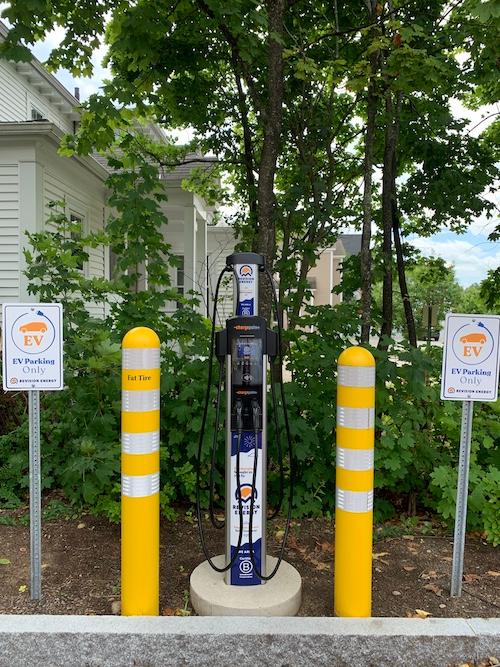
Lastly, a word about dog food. We can learn a lot from eating our own dog food, in the software/consumer-facing meaning of the term. ReVision Energy, through its affiliated ReVision Impact, intends to own and operate charging infrastructure throughout New England. Our first investment was in Concord, NH outside the state house, where we operate two dual pedestal level 2 chargers from ChargePoint.

Interestingly, because of the chargers’ location, they get regular bi-partisan use, (educating policymakers about public charging)! Their touch screen even educates drivers about the savings to be had from installing rooftop solar on their homes. Meanwhile we are learning about driver charging behavior, how to set rates per kWh (which have increased in NH significantly this year), the value of signage, and the economic model for operating these over the long haul.

Soon, ReVision Impact will be owning and operating its first DC Fast Chargers in Belfast and Ellsworth, ME, with more placements on the way.

(Note: At the time of writing, the federal tax credit eligibility cap just increased on EV MSRP and most manufacturers are lowering prices).

Filed Under: Under the Sun Blog Tagged With: by Barry Woods, EV Updates

EV Corner: Ford F-150 Lightning

January 9, 2023 by Ale Moreno

The Ford F-150 Hints at the Future of Fleet Electrification

Like many businesses, ReVision Energy maintains a fleet of vehicles to assist its sales force, service teams, and installers. We now have upwards of 180 vehicles, including seventeen plug-in electric vehicles, and eleven more on order, most of which are Chevy Bolts. Each branch also has charging stations on site for public, fleet, and employee use, with twelve Level 2 charging stations at our South Portland location alone!

Our workplace charging program has also encouraged a large number of ReVision employee-owners to buy electric vehicles (EVs) for their personal use. We continue to learn from our behavior (and it informs our strategic thinking and customer education) as we transition to fully-electric transportation, a task that is thankfully becoming easier. Our goal is to replace everything with plug-in electric vehicles as the products become available.

Eventually our entire fleet will charge using solar electricity, with vehicle batteries offering grid-connected bi-directional charging capacity to feed the building, avoiding demand charges and offering back up generation.
 

Does all this seem far fetched in 2023? Nope. The Ford F-150 Lightning pickup truck is the poster child for the future of fleets at businesses such as ours.  Recently we received our first F-150 Lightning; let’s take a moment to review it, considering the larger context of what this technology means.

The Ford F-150 Lightning

Lightning charging.jpeg

While the F-150 has been the best-selling combustion vehicle in the U.S. for the past 40 years, its newest and all-electric family member is sure to bring even more shine to the lineage. Sporting a battery sized from 98 kWh to 131 kWh and with over eleven outlets for appliances (including one that offers 30A 240V connection!), this vehicle is literally a power station.

Consumers can purchase a Home Integration System that allows for bi-directional charging at 9.6kW. The average residential household uses 20 kWh per day (likely to increase as we electrify everything), which means the truck’s battery is sufficient to power a residential home for 2-5 days before needing a recharge (which can be done with rooftop solar during daylight hours). When driving, the battery provides range of 230-320 miles at an average of 2.3 miles per kWh – not bad considering this is a BIG truck. 

Lightning Frunk 1.jpeg

The front trunk (“frunk”) is large and lockable (the first locking trunk embedded in a pickup design to our knowledge). It is a full-sized pickup with 4 x 8’ payload capable of carrying 2235 lbs and towing capacity of 7700 lbs (capable of 8500Lbs with the upgraded towing package)! Of course, towing dramatically impacts range which, depending on trailer weight, means 50% or more decrease in range. On the plus side, energy savings range from $50-$70 per 300 miles when compared to gas versions like the Raptor. As battery technology continues to improve, so will these numbers.

ReVision uses pickups for many tasks, including project management and deliveries, service calls, and marketing (we have to tow our Tiny Climate Classroom around the region!) Everyone who has driven it loves it. Look for our fully branded Lightning (soon to be joined by others) driving around your neighborhood, and expect to see it at EV events in your community as well.

For more info check out this great summary by Tom Moloughney: 2022 Ford F-150 Lightning: InsideEVs First Drive Review (Charging, Towing, and More!) – YouTube

Filed Under: Under the Sun Blog Tagged With: by Barry Woods, EV Updates

EV Corner: Driving Electric Makes $ense

November 28, 2022 by Ale Moreno

Driving Electric Makes $ense

As more Americans learn about the benefits of driving electric, the choice (and trade-offs) becomes clearer. So much depends on being critically minded and well informed. The fossil fuel industry has had over a hundred years of growth and political entrenchment; its economic and messaging power are, at times, breathtaking. The EPA even has an EV Mythbusting page on its government website. Misinformation includes vehicles running on “dirty” electricity, a lack of charging opportunities, and vehicle safety. 

Each of these myths has a weak foundation, but talking points like these are insidious. The bigger issues facing the clean energy and transportation transition are related to constructing a system whose benefits are accessible to every American, and which consciously places as little burden on the Earth as possible, leading to equity and sustainability. 

EV Accessibility

MicrosoftTeams-image (106).png

Equity can be partially addressed by bringing the cost of EVs down to a point where every American has options to purchase and operate them. Currently most luxury vehicle brands do have comparably priced EV versions. Yet auto manufacturers should be planning on creating vehicles that are affordable across all platforms and pricing options – sedans, hatchbacks, pick-up trucks.  We don’t need electrified Humvees; we need better transportation choices, including smaller scale, longer range passenger vehicles. While the technology, particularly the batteries, is in its infancy, we can see glimmers of the future with GM’s Chevy Bolt and Nissan’s LEAF as two of the more reasonably priced, longest range vehicles out there.

We also see state-based incentives as having a role in closing the current price gap. Efficiency Maine, for example, offers one of the most aggressive state rebates in the US for low income purchasers- $7500(!) These can be stacked with federal incentives to further reduce upfront costs.

The Cost of a Solar Gallon

In the US, where gas prices currently hover around $4 a gallon or more, electricity as fuel can dramatically reduce operating costs over the life of the vehicle—and it’s cleaner! ReVision Energy has recently updated our analysis of the value of combining rooftop solar and driving electric to determine the cost per “solar gallon” equivalency.

If you directed your PV array’s electrons to charge your vehicle and compared that energy cost to the cost of a gallon of gas, how cheap is a solar gallon? By our current calculations, we estimate the value of a solar gallon to be $0.84. Yes, that’s less than a dollar per gallon.

Hanover Nh Solar Ev Lewin

Our methodology uses the average fuel efficiency of American cars from 2020 (25.4 mpg) and compares it to the average efficiency of EVs (0.346 kWh/mile). We calculated the cost of a kWh of solar electricity based on about 500 of our recent residential projects, assuming they will be producing clean electricity for 25 years. Standard electricity provides considerable discount as well, $1.85, but clearly residential rooftop solar offers more dramatic savings. The lack of any significant annual maintenance costs only adds to this savings.

Per capita, Americans consumed 356 gallons per year of gasoline in 2020 (down for 414 gallons in 2019, pre-Covid). At $3.80 per gallon, that equates to $1352 per person per year. By comparison, at $0.84 per gallon, it would be $295.48 per person, or a savings of $1056.52 per year. How frequently can you save $1000 a year that benefits the environment and requires no more significant behavior change than learning to charge your cell phone?

Filed Under: Under the Sun Blog Tagged With: by Barry Woods, EV Updates

EV Corner: Maine’s DC Fast Charging Network

October 3, 2022 by Ale Moreno

Maine Leads the Nation in DC Fast Charging Technology

Our EV Corner column is written by Barry Woods, Senior Director of E-Mobility.

As more of us get experience driving electric, we come to realize that one of the few times we actually need public charging is to assist the battery in going longer distances. Tesla’s Supercharger network is perhaps the best current example of a DC Fast Charging (DCFC) network designed to allow drivers to cross the entire country by stopping briefly to charge up and continue on their way. Non-Tesla drivers have had “charging envy” (the opposite of range anxiety) when they passed one of their myriad charging clusters.

DCFC Network Expands

This is changing. Maine has begun a serious effort using Volkswagen funding (and soon federal infrastructure money) to grow out its non-Tesla DCFC network and now has 14 locations functioning or under construction.

ev-charging-rivian.jpeg

The speed of DCFC technology has been increasing as well as the vehicle batteries’ capacity increases, and Maine has now activated the first public ChargePoint DCFCers capable of 150 kW in the country, courtesy of a partnership between ChargePoint, Efficiency Maine Trust, and ReVision Energy.

ChargePoint owns and operates its new Express Plus 150 kW chargers at Maine Turnpike’s Kennebunk (north and south) and West Gardiner service plazas. These chargers are three times as fast as the older 50 kW versions and many newer model EVs can take advantage of them to compress charging times.

Our project manager Dan Robinson witnessed this firsthand:

“Within minutes of the Gardiner commissioning, we had a brand-new Rivian R1T with temp plates pull in. The owner was very excited to see the additional infrastructure. He was able to charge quickly and continue on his way North. At Kennebunk North plaza, also within minutes of commissioning being completed, the brand-new Proterra/Thomas school bus destined for Old Town ME, pulled in for a charge right out of the build factory in Kennebunk, WC Cressey and Son. We were able to get the driver on the ChargePoint app and charging before they headed off to the next DCFC on their route, Skowhegan Hannaford – part of the Phase 1 build.”

First of its Kind in the Country

ev-bus.jpeg

These are the first public facing 150 kW ChargePoint chargers in the country. ReVision is proud of its team for helping get these in the ground and save time for EV drivers. These projects are part of the State of Maine’s ongoing efforts to grow a fast charging network for non-Tesla vehicles that offers fast and reliable charging for residents and tourists to enjoy the state and help its environment through reduced carbon electrification.

Look for more news on ReVision’s ongoing role with electrifying transportation, including ReVision branded public charging to help further the transition and allow us to spread clean energy throughout New England!

Filed Under: Under the Sun Blog Tagged With: by Barry Woods, EV Updates

sidebar

sidebar-alt

Subscribe to newsletter

Which newsletters would you like to receive?

Consent Enjoy the Sun(Required)
Consent(Required)
To provide the requested information, we need to store and process your personal data. By submitting this form, you agree to allow ReVision Energy to store and process your personal data for this purpose. Please see our privacy policy for more information.

  • Merch Store

Sitemap

  • Solutions
    • Homes
    • Commercial
    • Service
  • Our Work
    • Projects
  • About
    • Our People
    • Social Impact
    • Our Locations
    • Careers
  • For Customers
    • Support & Service
    • Be A Solar Champion
  • News & Events
    • Releases
    • Press
    • Under the Sun Blog
    • Events and Webinars
  • Our Partners
  • Resources

Follow Us

General Contact

Contact one of our branches for sales and non-service inquiries, or email us at hello@revisionenergy.com

Service

Need support for your existing system? Contact our Service Team:
Reach us at (207) 747-0076 or open a Support Ticket.

South Portland, ME

(207) 221-6342

Map & Directions 

Montville, ME

(207) 589-4171

Map & Directions 

Brentwood, NH

(603) 679-1777

Map & Directions 

Enfield, NH

(603) 632-1263

Map & Directions 

North Andover, MA

(978) 308-9041

Map & Directions 

Westfield, MA

(413) 884-1000

Map & Directions 

Copyright © 2026 ReVision Energy. All rights reserved.

Privacy Policy | Terms