• Skip to primary navigation
  • Skip to main content
  • Skip to primary sidebar
Revision Logo Revision Logo
Solar Calculator Get Started
Get Started Solar Calculator
  • Solutions
    • Homes
    • Commercial
    • Service
  • Our Work
    • Projects
  • About
    • About
    • Our People
    • Social Impact
    • Our Locations
    • Careers
  • For Customers
    • Support & Service
    • Be A Solar Champion
  • News & Events
    • Releases
    • Press
    • Under the Sun Blog
    • Events and Webinars
  • Our Partners
  • Resources

Give us a call

Maine (207) 221-6342
New Hampshire (603) 632-1263
Massachusetts (978) 308-9041
Contact Us

OLD Solar Champion Stories

Solar for Small Businesses

September 1, 2026 by Mauricio Pence

In the face of rising electric rates, going solar is a smart move for small businesses.

Across New England, small businesses are struggling with increased utility costs. With electricity rates climbing, now is the perfect time for local organizations to take control of their energy future by switching to clean solar energy. We spoke with Commercial Sales Consultant Guy Marshall to explore how small businesses can leverage solar to control operating costs, lock in predictable electric rates, and make a meaningful climate impact.

Before joining the team at ReVision Energy, Guy ran his own small business, so he understands the various demands. In budgeting, when you generate a dollar of additional revenue it usually generates twenty cents of profit – but a dollar of cost cutting is a dollar of profit. When budgeting for the next year, many business owners will add an extra 5-10% for electricity rate increases; this means to make the same profit this year they’ll need to cut elsewhere, or increase prices.

“It was pretty nice to see the $1,000 electric bill go to $17 or $18,” says Alvin Chase, owner of Eastern Tire & Auto Service, in Rockland, ME. “I think it’s a critical time for us all to see what small steps each one of us can make, and one of the easiest things you can do is make a solar investment.”

“As a small business,” Guy says, “one of the ways to control costs is to get control of your electric bills. By fixing the cost of electricity, business owners can control a large part of their budget during a time of economic uncertainty and tariffs.”

Take Skillins Greenhouse, a family-owned business, for example. In 2025 they partnered with ReVision to install a 140-panel array on their Cumberland location. They have a 5 year ROI. Two Midcoast boat builders – RE Blood Boatworks in Newcastle and Artisan Boatworks in Rockport – have ROIs of 5 years as well. With this type of payback period, these local businesses will be harvesting 20+ years of free electricity. As Guy points out, there are very few other investments a business can make with such a strong ROI.

“For us the ROI was incredible,” says Alvin of Eastern Tire, “we covered the expense in just under three years. Today we pay only the monthly delivery fee for electricity. As you can imagine, I have made many financial decisions in my 37 years here. Without hesitation, constructing our own power supply was among the wisest and most profitable.”

Throwback Brewery, a craft brewery in North Hampton, New Hampshire, installed a 49 kW rooftop system in 2016 and have been reaping the benefits for almost a decade.

“Benefits such as the federal tax credit, renewable energy credits, and bonus depreciation made this project well worth the investment,” said founders Nicole Carrier and Annette Lee. “So even if you might not be like us (a small business striving to be as environment conscious as possible), you might just crunch the numbers and decide solar could be for you, too!”

Businesses can still claim the 30% Federal Tax Credit!

Contrary to popular belief, the 30% Federal Solar Tax Credit for businesses and nonprofits hasn’t disappeared – it’s just more complicated.

“The rumor is that everything’s gone,” Guy explains, “but that’s just not true.” In 2026, companies that are foreign-owned, foreign-influenced, or under foreign control face new compliance requirements. These rules also extend to the source of project funding. With over two decades of experience in the solar industry, ReVision has the expertise, manufacturer relationships, and knowledge base to help business owners take advantage of the tax credits under these new rules.

The budget bill passed in July 2025 also reinstated 100% bonus depreciation for commercial solar projects, which has been extremely beneficial for local businesses.

“This improves your cash flow,” explains Guy. “In the year the array is completed, you can take both the tax credit (if entitled) and 100% bonus depreciation. It means the money you paid for the array comes back to you faster. If, for example, you paid $100,000 for the array with the 30% tax credit and depreciation expense, you get approximately 50-55% back in year one.”

Show Your Values

On a micro-level, going solar is a concrete climate action. In a time when environmental policy is largely being revoked at a federal level, it can feel difficult to actually make a difference.

“Instead of getting mad at political parties, seize your own change,” says Guy. “By going solar you can contribute in a very real way to saving the environment and taking control of your energy independence.” And customers care about this. A solar array sends a message to customers and shows that the business values sustainability, they value quality, and they value a better future.

“While all the projects we’ve done have had good economic value, you have to look beyond that a little and say ‘What do our customers want?’ and ‘What is right for the planet?’ and find that balance,” explains Michael Halle, President of Paradise Park in Old Orchard Beach. “You can come spend a week at Paradise Park, enjoy heated pools and hot tubs, air conditioned rental accommodations, and have essentially no carbon footprint! It’s a great example showing that humanity and nature can coexist and have paradise together.”

A Variety of Financing Options

There are many ways small businesses can go solar. In Maine, there are low-interest loan options available through Coastal Enterprises, Inc. (CEI) as well as the Dirigo Business Incentives program for Maine businesses.

Massachusetts’ recently launched SMART 3.0 program gives projects a nice boost by providing an incentive for every kilowatt hour the system generates for 20 years. The exact incentive amount depends on a few project characteristics, but that’s still monthly revenue for your business alongside energy savings. Compared to traditional net metering, this long-term incentive makes solar in Massachusetts one of the most financially attractive options in New England.

ReVision Energy experts work with our customers to help them navigate the various credits and incentives available, and choose the structure that works best.

“At the end of the day,” Guy says, “you get to do something good for our planet AND save money. And if enough people do it? That’s a significant impact on the environment.”

Interested in working with Guy or another of our Commercial Sales Consultants on a free solar quote for your business? Fill out this form or send us an email: hello@revisionenergy.com

Filed Under: Under the Sun Blog Tagged With: by Jill McLaughlin, OLD Solar Champion Stories

Celebrating 150 Years of the Appalachian Mountain Club – and Powering the Next 150 Together

June 9, 2026 by Mauricio Pence

We love partnering with local, mission-driven organizations, especially one that shares our commitment to strengthening communities and protecting the planet. And we’ve been partnering with the Appalachian Mountain Club (AMC) for over a decade – their first solar installation with ReVision was way back in 2015, a 73 kW array at Cardigan Mountain Lodge.

Many ReVision employee-owners love hiking, skiing, and camping in the AMC network. For years, we’ve met other AMC members at lodges, said hello on the trails, and helped transform AMC’s energy production into one that is clean, reliable, and future-proofed.

As regular blog readers may know, ReVision offers discounts to employees of our commercial solar partners. Employees of solarized companies like Bangor Savings Bank, PROCON, and Trillium Brewing can access special offers to install solar, heat pumps, or battery storage on their own homes. Employees of Appalachian Mountain Club obviously qualified, but the exciting news – we’re now extending that offer to all AMC members.

To celebrate AMC’s 150th anniversary, AMC members in New Hampshire, Maine, and Massachusetts are eligible for a special discount on clean energy technologies from ReVision Energy: $500 off solar, $500 off battery storage, and $250 off heat pumps. 

Are you an AMC Member? Sign up below to get started. Not yet a member? That’s an easy fix.

Request a visit

I'm interested in solar technologies for my:
Name(Required)
Which technologies are you interested in?
Consent(Required)
To provide the requested information, we need to store and process your personal data. By submitting this form, you agree to allow ReVision Energy to store and process your personal data for this purpose. Please see our privacy policy for more information.

Since that first 2015 installation, we’ve continued our partnership with AMC through a variety of educational workshops, outdoor events, and additional solar installations. In 2023 we installed rooftop and ground mount arrays for AMC’s Highland Center in Crawford Notch, and in 2024 we solarized their Cold River Camps.

The AMC Staff in front of the Highland Center ground mount array.

“I’m pretty fortunate that I grew up with the AMC in my life,” says ReVision’s Project Manager Travis Genatossio. “My parents would always take us out into the wilderness for hiking, canoeing, backpacking. So from an early age, we were family members of the Appalachian Mountain Club. I also went to college here in New Hampshire, and we spent a lot of time participating in the services that the AMC offers. So I personally have benefited from places like the Highland Center Lodge in the wintertime as a refuge under cold icy conditions, and in the summertime with the hut system.

Being able to provide, through my career, solar energy systems the AMC was particularly special because I have been connected with them for a long time.”

In total, AMC now has 496 solar panels, producing an estimated 234,168 kilowatt-hours of clean solar energy every year. In addition to proving their commitment to our planet’s preservation, their solar also reduces their electric bills, allowing them to put more money into services and events for members.

“Partnering with an organization like the AMC is great,” says Solar Consultant David Webb, who has helped many New Hampshire nonprofits go solar. “Anything that we can do to help them lower their operating expenses will help the viability of the organization in the long term. And AMC has been around since the late 1800s, so they know a few things about longterm stability!”

AMC’s Solar Stats:

Cardigan Mountain Lodge (2015):

  • Size: 73.20 kW DC
  • Estimated Annual Generation: 86,888 kWh est annual generation
  • 240 panels 

Highland Center Lodge (2023)

  • Size: 94kW DC
  • Estimated Annual Generation: 118,151 kWh
  • 160 panels on a ground mount, 44 panels in their rooftop system

Cold River Camps (2024)

  • Size: 24.96 kW DC
  • Estimated Annual Generation: 29,129 kWh 
  • 52 Panels

Total:

  • 192.2 kW 496 solar panels
  • 234,168 kWh annual production
  • Offsetting 346,844 pounds of carbon each year
  • Equivalent to the carbon sequestered by 2600 tree seedlings, or 158 acres of forest.

Filed Under: Under the Sun Blog Tagged With: OLD Solar Champion Stories

Solar is a Resilient Investment

May 11, 2026 by Mauricio Pence

Don’t stuff your cash under your mattress – install it on your roof!

With a volatile stock market and rising electricity costs, many Americans are looking for steadier ways to put their money to work. Investing in solar energy delivers a strong return, locks in your largest controllable household expense, and builds long-term resilience into your home and your finances.

Solar is not a magic asset that always beats the stock market. It’s something better in some respects: a real, predictable return that flows back to you every month in the form of avoided utility bills, with benefits that go well beyond dollars on a chart.

How solar stacks up against the S&P 500 

Let’s compare three options for a New England homeowner with $24,000 to put to work: 

  1. Cash solar — Buy an 8-kW system outright for $24,000. 
  2. Financed solar — Same system, financed with a 20-year solar loan at 6.99% (~$186/month). 
  3. S&P 500 — Invest the $24,000 in a broad-market index fund. 

Over 25 years, the cash solar purchase and the S&P 500 investment finish in roughly the same place — over $100k in net financial benefit. The financed solar option ends up around $87k. It’s lower because of loan interest, but it requires no money down and turns cash-flow positive immediately as monthly bill savings exceed the loan payment. 

In other words, solar delivers stock-market-comparable returns — but with a very different risk profile. 

Assumptions behind the numbers 

The model uses a $24,000 8 kW system (about $3.00/W installed), 10,000 kWh of annual production with 0.4% yearly degradation, a starting electricity rate of $0.28/kWh growing 5% per year, and $30/MWh in renewable energy certificate revenue with modest annual decline. The S&P 500 assumes a 7% nominal annual return, roughly the long-term historical average. Your actual results will vary based on your specific roof, utility rate, and market conditions. Many New Englanders pay more than $0.28/kWh today for their grid electricity which makes solar even more compelling. 

Why solar’s “comparable” return is actually better 

The S&P 500 has averaged around 7% annually over the last century, but that average hides enormous volatility. The market lost 37% in 2008, dropped 19% in 2022, and earlier this year saw trillions of dollars in value evaporate within hours amid tariff turmoil. Long-term investors have been rewarded for staying the course, but the ride is bumpy. 

Solar’s return looks different in three important ways: 

  • Predictability. Your panels produce roughly the same amount of power every year, regardless of what’s happening on Wall Street. Returns are determined by sunlight and your utility rate — not investor sentiment. 
  • Inflation protection. Utility electricity rates tend to rise with inflation, and often faster. Maine residents saw their total residential electricity bills jump roughly 10% between early 2025 and early 2026. When your utility raises rates, your solar production becomes more valuable, automatically. 
  • Tax efficiency. Bill savings from solar are not taxed. Stock gains are subject to capital gains tax (typically 15–20% on long-term gains for most households), which trims the headline S&P return when you eventually sell. 

Solar Investment: A Virtuous Cycle 

Unlike a brokerage account, a solar investment pays you back in many ways at once. A solar electric array can increase the value of your home and lower your cost of ownership. The money you spend on a solar project flows back into your local economy rather than out of state to fuel suppliers. The environmental return is harder to put on a chart, but reducing air and carbon pollution helps your community immediately and our shared planet indefinitely. 

Owning a solar electric array also comes with powerful peace of mind. No matter what happens to fuel prices or grid reliability, you own a steady stream of clean power for your home. 

Take control of your future 

As energy prices continue to climb, the returns from a solar energy system get more attractive. Homeowners who have invested in solar — and renters with a Member-Owned Community Solar share — can enjoy reduced or fully offset monthly electric bills from the clean energy they produce. 

While it’s tempting to hold onto cash during uncertain times, your future self will be glad you put that money to work in solar and took control of your energy future. Whether you pay outright or finance with a solar loan, you can lock in tomorrow’s electricity costs at today’s rates. This time next year, you could be enjoying that sweet solar energy and watching your savings climb. 

Filed Under: Under the Sun Blog Tagged With: OLD Solar Champion Stories

Electrotech Is Immune to the Strait of Hormuz: The New Joule Order

May 6, 2026 by Mauricio Pence

From our bird’s-eye view of the renewable energy industry, we often see positive developments for humanity before they become common knowledge. The purpose of this column is to highlight the clean energy innovations and sustainability actions that are legitimate cause for optimism despite the very real threats to people and the environment posed by climate damage.

by Co-Founder Phil Coupe
 

‘Energy dominance’ has been a buzz phrase of the current U.S. administration, but energy chaos is the reality as costs for gasoline, oil, natural gas, and electricity lurch upward due to the Iran war, closure of the Strait of Hormuz, and Russia’s war on Ukraine.

‘The New Joule Order‘ is a more accurate phrase recently coined by Jeff Currie to describe how nations are accelerating renewable energy and electrotech investments to bolster national security and stabilize energy prices in the face of vulnerable fossil fuel supply chains, and extreme energy price shocks. (A ‘joule‘ is a unit of energy)

New England states are uniquely exposed to tectonic energy shifts because we import 100% of our oil and gasoline. We are forced to pay some of the highest prices in the U.S. as we have zero control over the supplies and global market forces that impact costs. The more we continue to over-rely on energy imports, the more exposed we are to volatility and supply disruptions (like  the Strait of Hormuz), robbing us of energy security, independence, and resilience. Local, cost-effective renewables and electrotech (EV’s, heat pumps, battery storage) are gaining traction as the most powerful solutions to this problem.

“It’s a great feeling knowing you don’t have to worry anymore about energy issues around the world. I have enough going on in my life. Not having to worry about energy and gas prices is an amazing feeling.”— Tim G., ReVision Energy Solar Champion

Geography matters when it comes to the viability of renewable resources to supplant fossil fuels. Maine, New Hampshire, and Massachusetts are fortunate to be at a relatively sunny latitude (same as Monaco on the French Riviera) and our region has been described as the ‘Saudi Arabia’ of wind due to strong offshore and mountaintop breezes.

At scale, electricity generated by wind and solar have become the cheapest form of power, and they can be deployed faster than any other source of new generation. These two facts enable local communities to derive a strong economic return from solar and wind investments while increasing local energy independence, security, and cost control. 

In the New Joule Order, solar and wind are not just intermittent hedges against utility rates and liquid fuels; they are increasingly efficient generation assets that can be paired with electrotech to deliver systemic resilience and stability.

As Chief Strategy Officer of Energy Pathways at global investment firm Carlyle, Currie notes in his New Joule Order investment thesis that energy security has overtaken climate concerns as the primary force driving the renewable energy transition. Nations around the world are hastening the adoption of renewable energy and electric technologies as the most effective strategy to protect themselves from the price volatility and supply instability of fossil fuels. Confirming Currie’s perspective is the fact that in 2025 global investors put $2.3 trillion into clean energy and $1.1 trillion into fossil fuels.

Through its relentless attacks on renewable energy, vociferous support for fossil fuels, and climate disinformation, the Trump administration has pushed environmental concerns off the stage. Simultaneously, the administration has dramatically increased demand for renewable energy and electrotech, both domestically and abroad, by inflicting global energy price shocks and supply disruptions through the Iran war.

“We are so grateful to be retiring with a budget that does not include any gas, oil, or electricity, and no contribution to the wars we fight over oil supply. The only contributions we want to make are the ones that slow the changes in our climate.”— Beth M., ReVision Solar Champion

We see cautious, rational cause for optimism in the truth that local renewable energy paired with hyper-efficient electrotech has become the most cost-effective and resilient antidote to the fundamental weaknesses of fossil fuels. Oil and gas are finite and depend on increasingly fragile supply chains in a destabilizing world; they are extremely hard and energy intensive to forage and transport; on a vast scale they are gravely damaging the environment we all depend upon for survival. We would never choose murderous geopolitical conflicts as the pathway to an energy transition, but we are secure in the knowledge that the future belongs to energy systems that are local, renewable, financeable, and fast to deploy. Welcome to the New Joule Order powered by an unstoppable Electrotech Revolution.

“Sunshine doesn’t have to pass through the Strait of Hormuz.”— Vermont-based climate activist Bill McKibben

Filed Under: Under the Sun Blog Tagged With: OLD Solar Champion Stories

Powering the Community: Jaffrey’s Solar Landfill

April 28, 2026 by Mauricio Pence

The only thing better than turning a capped landfill into a solar field? Sending 100% of the energy it produces to local low- and moderate-income families to help offset their electric bills. 

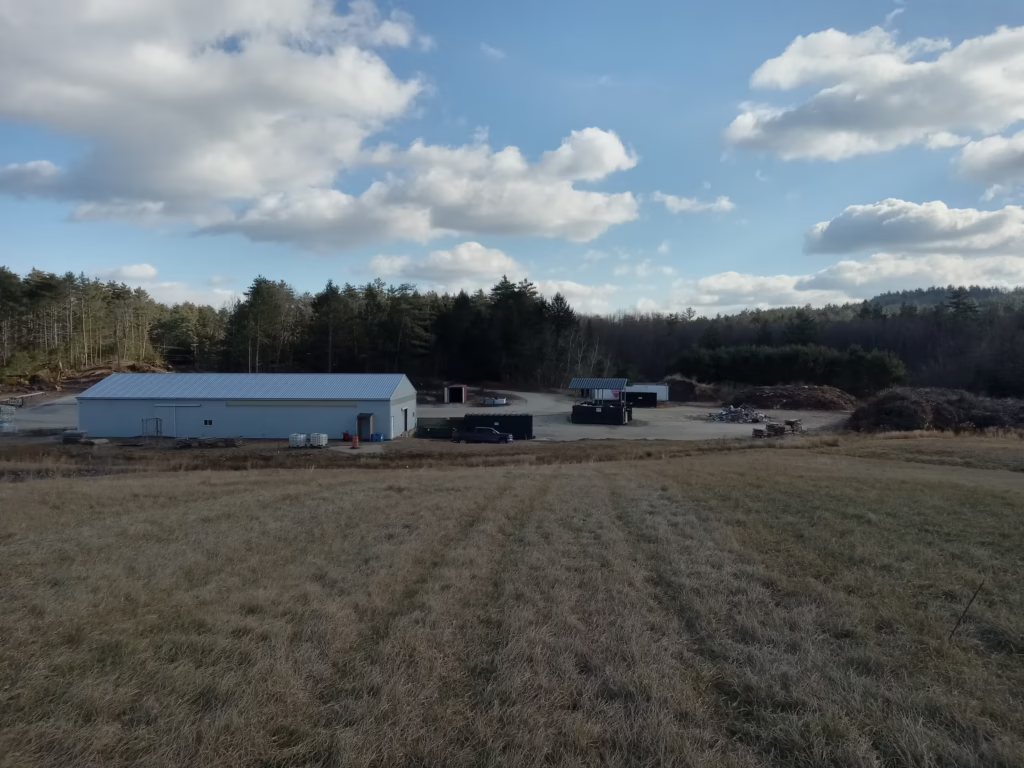
ReVision Energy has partnered with the Town of Jaffrey, New Hampshire to develop a new community solar array on top of a former municipal landfill, transforming underutilized land into a long-term source of clean energy and local revenue. Construction on the project is underway, with the solar array expected to come online in early 2027. 

This project is a clear win-win: a productive reuse of land that isn’t suitable for other development, paired with meaningful economic and environmental benefits to the community.

How Does This Work? 

Under the agreement, the Town of Jaffrey will lease the capped landfill site to ReVision Energy for the solar installation and receive annual lease payments of $10,000, with an escalator over time.

“It’s the perfect use of land that can’t do anything else. This project generates value for the town while supporting families who need energy savings the most.”— Jon Frederick, Jaffrey Town Manager

ReVision is leading development and construction of the array. Financing for the project is provided by Blue Haven Solar, a solar financing entity of Blue Haven Initiative. Blue Haven is a family office that makes impact investments to achieve financial returns alongside positive social and environmental impact.

The collaboration reflects the shared mission of Blue Haven Solar and ReVision Energy to accelerate the transition to clean energy while expanding access to solar savings for low-income communities. The 1.34 megawatt community solar array will be powered by 2,266 U.S.-assembled solar panels, and will generate more than 1.7 million kilowatt hours of electricity each year, while offsetting 933 tons of carbon pollution.

Once operational, 100% of the energy produced by the community solar array will benefit some 250 low- and moderate-income households enrolled in (or on the waitlist for) the state of New Hampshire’s Electric Assistance Program (EAP). Participants are projected to receive up to $2 million in bill credits during the life of the system. Participants will be enrolled in the Energy Assistance Program for Low-Moderate Income (EAP LMI) Community Solar, allowing them to receive direct savings of 25% off the electricity supply rate in their utility bills.

Member selection and enrollment will be managed by Eversource, the local utility, and guided by criteria established by the New Hampshire Department of Energy. Priority will be given first to EAP customers and waitlist households in Jaffrey, followed by eligible customers in neighboring towns, helping to ensure that energy savings accrue locally. If demand exceeds available spots within any priority category, participants will be selected through a randomized process.

By converting a closed landfill into a community solar resource, the Jaffrey project demonstrates how municipalities can creatively repurpose constrained land to meet clean energy goals, support local budgets, and deliver tangible benefits to residents most impacted by rising energy costs. ReVision has worked with local communities to install solar projects on 11 landfills in New Hampshire and Maine, with three more slated for completion by 2027.

“This project shows what’s possible when communities, clean energy developers, and mission‑driven partners come together,” said Mark Zankel, Director of Community Solar at ReVision Energy. “By transforming a capped landfill into a source of clean power and directing 100 percent of the energy to households enrolled in the Energy Assistance Program, the Jaffrey Landfill community solar array will transform an underused site into meaningful, long‑term benefits for the community and for Granite Staters who need it most.”

Filed Under: Under the Sun Blog Tagged With: OLD Solar Champion Stories

Why We’re Finally Offering Solar Leasing, Designed Around Our Customers

April 2, 2026 by Mauricio Pence

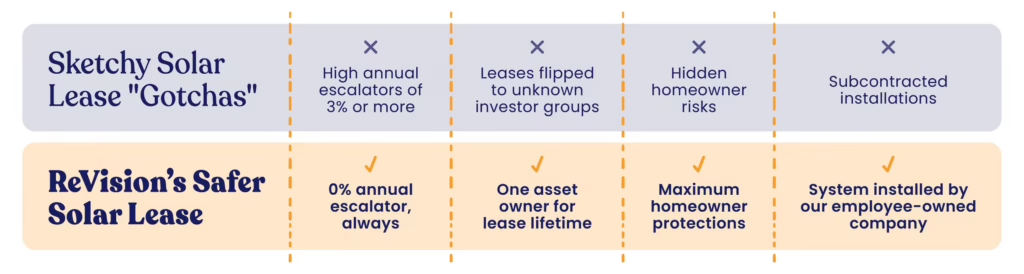
For most of ReVision’s history, we’ve advised people against solar leasing. And for most of solar leasing’s history, companies have structured them to benefit the financier, not families looking for energy stability. Leases have traditionally come with high annual escalators, unclear system ownership, and disappearing installers. To make things worse, leasing companies are often associated with intimidating sales tactics that have negatively impacted the entire solar industry.

As an employee‑owned B Corp, we take pride in delivering solutions that put people first. We’re committed to transparency, long‑term value, and our vision of a just and equitable electric future for all New Englanders.

So why now?

Energy prices are skyrocketing and people are looking for solutions. Meanwhile, the federal administration removed the federal solar tax credit for homeowners but kept it for corporations. ReVision, in conjunction with other member companies of the nationwide Amicus Solar Cooperative, decided to get creative. ReVision employee-owners have been hard at work developing financing options that make solar more accessible and affordable, by leveraging the ongoing commercial solar tax credit.

“I have honestly never seen such good economics for solar, and I’ve been in the industry for a long time.”

— John Luft, Sales Manager, ReVision Employee Since 2004


Our Safer Solar Lease

With zero money down, you can enter into a 25‑year solar lease. Because our lease has a 0% annual escalator, you’ll enjoy a fixed monthly payment that’s lower than your current electric bill, and that monthly payment will never change. If your payment starts at $110 per month, it will still be $110 per month in 2050. As utility rates continue to rise, your savings grow right along with them. Plus, our leasing partner owns the system so maintenance is handled at no cost to you.

Learn More About Our Solar Lease
 

This is a great option for people who want zero upfront cost, predictable monthly payments, and minimal responsibility. This is also good for people on a fixed income looking for longterm energy stability.

PowerPath Financing Option

Alternatively, customers can now leverage the commercial tax credit through our PowerPath financing option. By partnering with Amicus Cooperative (made up of ReVision and our trusted, mission-driven partners), we can offer up to 30% off the total cost of the system. (This is in some ways preferable to using the previous tax credit because you get the discount immediately instead of waiting to file next year’s taxes).

Amicus owns your system for the first 5 years (due to IRS requirements) while you own all of the energy it produces from day 1. After 5 years, ownership can transfer to you. This option is great for people who want to ultimately own their system, but missed out on the pre-2026 tax credit and still want to get up to 30% off the total cost.

Unlike traditional financing options, there’s no for-profit financing company needing to make shareholder return. That means fewer fees, fewer complications, and a program built by a cooperative specifically to support the growth of solar, not to generate profits for third parties.

Learn More About PowerPath

Both Options Are Equally Good for the Planet

No matter how you choose to pay for solar, the environmental impact is the same. Every kilowatt-hour you produce on your roof is clean energy that cuts carbon emissions and reduces air pollution. By going solar – whether through a lease, prepaid lease, or any of our other models – you’re helping us create the better future we know is possible for our kids and grandkids.

Filed Under: Under the Sun Blog Tagged With: OLD Solar Champion Stories

Spring Service Health Check: How to Ensure Maximum Solar Production

April 1, 2026 by Mauricio Pence

For solar arrays, springtime means peak production – but only if your array is functioning properly.   

If your first reaction is, “I assume everything is fine,” you’re in good company. Most Solar Champions only discover a problem when a bill looks weird, the app hasn’t updated, or they notice it after the spring sun is already here. 

Now’s the perfect time for a quick solar health check. Our experienced in-house service team put together a simple checklist to help you make sure everything is running smoothly. Take a look, and give us a call if you have any issues or questions. We’re here to help.  

  1. Monitoring – Check Your App & Inverter  When was the last time you checked your solar monitoring? Take a moment to open the app and confirm you can see production data. Check your inverter and make sure those lights are green.  If you can’t connect with your system, or if you see any errors or red lights, give us a call – we can help troubleshoot remotely, or schedule a service visit. 
  2. Critters – Check Your Roof As it warms up, our friendly neighborhood critters (squirrels, chipmunks, mice) start scouting new nesting spots. This can be extremely damaging for solar arrays and wiring.From the ground, do a quick scan: 
    – Any obvious nesting debris near the array? 
    – More squirrel activity than usual? 
    – Recent tree removal in your neighborhood (which can push critters to new roofs)?

    If you see any of this, that’s a sign you may need to install critter guard. We can talk through whether or not this makes sense and give you a quote.  
  3. Electric Bill – Check Your Usage & Production  Take a look at your most recent electric bill, and double-check that your utility is tracking and crediting your solar production correctly. We know electric bills can be confusing. We’re happy to walk through it with you — sometimes the system is fine and it’s just a billing/credit display issue, and sometimes we catch something worth addressing early.

That’s it! If everything looks good, your array is all set to crank out some clean kilowatt-hours for you this spring and summer. If you’re not sure – give us a call! We can walk through any of this with you over the phone. 

ReVision Energy Service Dispatch Number:
207-747-0076

(we’ll connect you to your local branch for any in-person service calls)

Filed Under: Under the Sun Blog Tagged With: OLD Solar Champion Stories

This Solar Array Directly Impacts Young People

March 25, 2026 by Mauricio Pence

New Hampshire-based nonprofit Friends Forever International has a straightforward mission: to help youth become the best versions of themselves so they can help their community become the best version of itself. Although headquartered in Durham, NH, they run programs around the world that empower youth from diverse backgrounds to tackle local and global issues. Although they went solar with ReVision Energy in 2016, they are now looking to expand their solar energy production with a second array – and they’re hoping to fund it with community-driven donations.

Two quick points you need to know about FFI’s solar fundraiser:

  1. Every young person involved with an FFI program is fully funded.
  2. The financial savings from their solar array go directly to these student scholarships.

“It’s not theoretical,” FFI’s CEO Stephen Martineau explains. “Every couple thousand dollars we save is an extra scholarship. I look at the books and when our electric bills go down, I tell our program director that we can take more students.”

Help FFI Take More Students

Their existing 18 kw solar array, installed on their Durham office by ReVision Energy in 2016, has performed well, generating over 142 megawatt-hours of clean energy. But as electric rates increase, and FFI works to get away from fossil fuels on their campus, they need more solar energy to offset their bills.

Live Free or Die: Solar Creates Independence

“We love working in New Hampshire and our community here is so supportive,” says Stephen. “But New Hampshire is 50th in the nation in charitable giving per capita. As nonprofits, we can’t just be frustrated by that. We need to find creative ways to make up the difference through dollars earned or donated – or dollars saved. When we looked at our budget, our energy bill was the best way to save money.”

Before going solar in 2016, FFI had an energy audit done, and has worked to weatherize their buildings. They’ve cut down on costs as much as possible, and are lean on staffing, events, and other organizational expenses.

“For us, solar is also about independence,” says Stephen. “The more a nonprofit can avoid the variables and chaos of the world, the stronger it becomes. We emphasize reliability and independence in the young people we work with, and solar is a tangible way of doing that for our organization. Our energy rate will be steady because we’re doing solar, regardless of what happens in the world.”

The Best Version of a Community is Solar-Powered

The educational and demonstratable use of solar is also important to FFI. FFI models the behaviors they teach: they operate a fully plant‑based campus, encourage energy conservation and composting, and have rewilded their outdoor spaces to support native pollinators. Solar is the final major element of a long‑term sustainability strategy that they hope will inspire the local community. More than 20,000 cars pass FFI’s uniquely colored farmhouse each day on Route 4. With a new solar array on its roof, the building will become a visible reminder that solar belongs everywhere, including traditional New England buildings.

As an organization rooted in conflict-resolution – the first group of FFI leaders were based in Northern Ireland in 1986 – safety and security are top priority when establishing programming. And solar is an integral part of that security plan.

“Safety, security, and solar. That’s the model we’re using as we build out our hubs,” says Stephen. “You can’t plan for young people or the future without thinking about energy. It sits at the intersection of mental health, global conflict, and every challenge our communities face.”

Why Donor Support Matters

For many nonprofits, the greatest barrier to solar is the upfront cost, even though long‑term savings are significant. This is where donor support becomes critical.

Every contribution to FFI’s solar project helps:

  • expand scholarships for young people in our communities
  • reduce operational expenses
  • build organizational resilience
  • model environmental responsibility

The impacts are immediate, and clear. When FFI reduces their electric bill by going solar, they help more young people become leaders in their communities – including right here in Maine and New Hampshire.

Help Power FFI’s Future

Filed Under: Under the Sun Blog Tagged With: OLD Solar Champion Stories

Commercial Solar in Action: Two Case Studies in Long-Term Energy Savings

March 16, 2026 by Mauricio Pence

With over 23 years of experience in the solar industry, ReVision Energy has helped many commercial property owners make smart energy decisions, even as incentives, financing options, and regulations continue to evolve. From navigating complex incentive programs to aligning solar installations with critical financing timelines, ReVision serves as a trusted partner throughout the entire process.

For developers like Elm Grove Properties and Tamposi Brothers Holdings, that experience has translated into high‑performing solar systems and predictable long‑term energy costs.

Interested in exploring solar for your own business or property? Get in touch. 

Case Study: Elm Grove Properties

First Installation: 2023
Total annual energy generation: 618,240 kWh/year
Properties with solar: Depot and Main, Country Brook, The Rapids, Hale Crossing

Elm Grove Properties has partnered with ReVision Energy across multiple projects, including solar arrays for both new construction and existing facilities, as well as EV charger installations on a recently completed development. The goal: maximize energy production while maintaining efficiency, cost competitiveness, and tight construction schedules.

Results:

  • High‑performing solar systems across multiple properties
  • Seamless coordination with new construction projects
  • Long‑term partnership built on trust

“ReVision Energy’s design team consistently delivers solutions that maximize energy generation while maintaining efficiency and competitive pricing. Their construction team produces high-quality work and reliably delivers projects on schedule. During the close-out phase, documentation is completed promptly, ensuring projects become fully operational without delay.

Throughout the design, construction, and closeout phases, ReVision Energy demonstrates a high level of professionalism and responsiveness. Elm Grove Companies looks forward to continuing its partnership with ReVision Energy.”— Elm Grove Companies

Case Study: Tamposi Brothers Holdings, LLC

First Installation: 2024
Total annual energy generation: 709,596 kWh/year
Properties with solar: Avery Lane Apartments (Phase 1 & 2), Pembroke Road Apartments (3 buildings), Brookline Woods (Phase 1 & Clubhouse Phase 2), Courtyard Apartments

Results:

  • Stable, predictable electricity costs for decades
  • Solar integrated across multiple multifamily developments
  • Reduced risk during regulatory and financing approvals

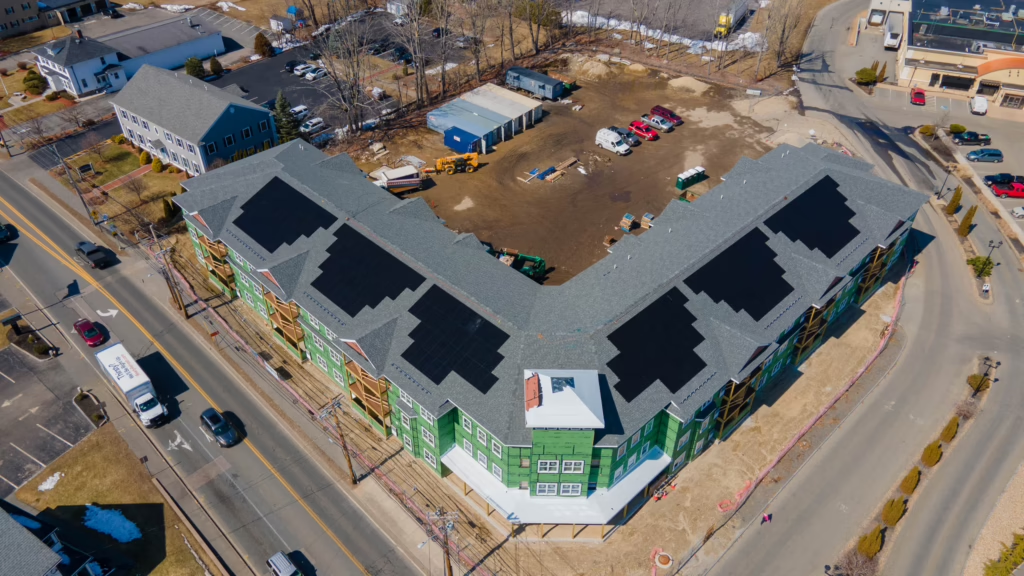
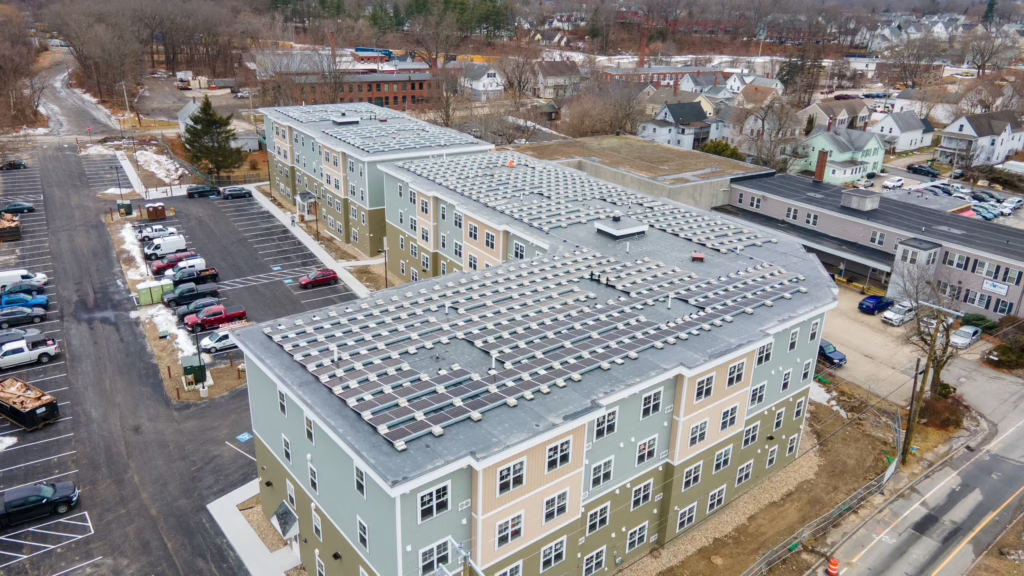
Between 2024 and 2026, ReVision Energy partnered with Tamposi Brothers Holdings to install solar across six multifamily housing developments. Each project was designed with a long‑term strategy in mind: locking in electrical costs for 25+ years while reducing exposure to rising utility rates.

“ReVision has been an outstanding partner in bringing solar to our multifamily development projects. Their knowledge and expertise have been extremely important in helping us as owners to navigate the changing regulatory landscape and ensuring that we have been able to install our solar arrays efficiently and on time for key financing deadlines.

ReVision’s staff is friendly, approachable, responsive, and easy to work with! Because they are so experienced, we don’t have to worry about micromanaging the process and can be confident that ReVision will get the job done.”— Joseph Tamposi, Founder

A Smarter Energy Strategy for Commercial Portfolios

From mixed-use developments to large multifamily portfolios, commercial solar can scale across diverse property types when projects are designed with long‑term performance, cost certainty, and operational simplicity in mind. For property owners and developers, solar is no longer a one‑off upgrade. It’s a strategic asset that delivers measurable value year after year.

Learn More: Get a Free Quote for Your Own Property

Filed Under: Under the Sun Blog Tagged With: OLD Solar Champion Stories

Don’t Miss Out on the 30% Federal Tax Credit for Businesses

March 11, 2026 by Mauricio Pence

For many years, federal incentives have helped businesses move toward a more affordable, resilient, and sustainable energy future. The 30% federal Investment Tax Credit (ITC) has been one of the most meaningful ways to reduce the upfront cost of installing a solar system. Under the federal energy bill passed last July, this incentive is sunsetting, and the window to secure it is closing.

At ReVision Energy, we want business owners across our region to have the information they need to make responsible, confident decisions. If you’ve been considering solar, battery storage, or an expansion of your existing solar array, now is the time to take a closer look.

Two Ways to Secure the Full Credit 

  1. You meet one of the IRS “Start of Construction” tests by July 4, 2026, and complete your project by the end of 2030.
  2. Your solar array is complete and placed in service by the end of 2027.

ReVision Energy Safe Harbor Deadline: May 1, 2026

To help Solar Champions secure the tax credit with confidence, ReVision Energy has established a Safe Harbor deadline of May 1, 2026.

To qualify for safe harbor with ReVision, you must:

  • Be under contract with ReVision Energy by May 1, 2026.
  • Submit your project deposit before we make safe harbor equipment purchases in June 2026.

Safe harboring helps ensure your project remains eligible for the full tax credit even as federal incentives begin to phase out.

Going Solar Now is Good for Business

For years, business owners across Maine, New Hampshire, and Massachusetts have stabilized their expenses and increased their business by going solar with ReVision Energy. Going solar now allows you to:

  1. Maximize your tax savingsThe ITC is a meaningful incentive that reduces upfront cost. Securing it now helps improve your project’s return on investment.
  2. Stabilize long‑term operating expensesElectricity rates continue to rise across the region. Solar locks in a low electric rate for decades to come, helping protect your budget for the long haul.
  3. Advance your sustainability commitmentsSolar energy reduces carbon emissions and helps build a more resilient local energy economy. It’s a straightforward step toward companywide sustainability goals.

ReVision Energy has Decades of Experience

We’re known for our solar installations, but we offer a variety of solutions to help your business. From battery storage to EV charging, our skilled employee-owners are ready to help your business save money and attract new customers. 

Beyond the federal tax credit, we can also help you identify local and state incentives for your project. 

Sound interesting? Get in touch with our commercial team.

Filed Under: Under the Sun Blog Tagged With: OLD Solar Champion Stories

Women in Construction Month

March 4, 2026 by Mauricio Pence

Nationally, women make up only 11% of the construction industry, a painfully low percentage given how essential this field is to the clean energy transition. To achieve the just and equitable electric future we know is possible, we need to increase the number of women entering the industry – and part of that involves celebrating Women in Construction Week annually every March. 

We asked just a few of the incredible women working for ReVision Energy to shed some light on the construction industry – how they got into it and what advice they’d give to women considering it. 

Meet Steph, Hannah, Diana, Lamara, and Rachel – all ReVision Energy co-owners and critical to the construction field. 

What Advice Would You Give to Women Considering a Construction Career? 

“Try it out before you discredit anything! If you want to be in the field, explore trade school or in-house apprenticeship opportunities like at ReVision. It can be easy to listen to other’s (often stereotypical) assumptions of male-dominated industries like construction. But you truly don’t know if it’s for you until you try it, regardless of gender. I’ve worked in a couple of different male-dominated industries and have always found that people just want to know they can trust and rely on their team. If you show up with work ethic and contribute, you will be welcomed in any industry.”

—Steph Walsh, Operations Coordinator, North Andover

“Advice I wish I had when I first started would be – don’t be afraid to ask questions. This is a big industry, and it is okay if you don’t understand or need clarity. Curiosity is a strength and not a weakness. It is important to be able to come to the table, ask good questions, and stay curious. This is where learning happens. I have also come to learn that leadership doesn’t have to be loud and strong; there is a place for kind and patient leadership.” 

—Hannah Haskell, Facilities Manager, Montville

“My advice to women entering the trades is to go for it! Don’t worry about what others think – as long as you’re doing what you love, nothing else matters. The world is changing and a lot of men and customers in this field are realizing that women are just as good and sometimes better depending on the situation.”

—Diana Przechocki, Solar Advisor, Westfield

“Be ready to be assertive, bold, and a little aggressive. If you are unable or unwilling to have these characteristics, this may not be the right field for you. Working with other contractors or inspectors, you must be willing to stand firm. ReVision isn’t this way but I have worked for other construction companies with men who will talk down and make you feel little because you are a woman in “their” field. Be strong-willed, we are the minority in this field!”

—Rachel Bruso, Residential Project Developer, Westfield

“I would say let the work guide you, and trust yourself. If you know what you want to learn and achieve through your work, and you’re focused on contributing to that, you can take yourself where you want to go.”  

—Lamara D’Arbeloff, Facilities Manager, North Andover

“The other thing to consider is if the field work doesn’t interest you, or isn’t a good fit, there are MANY in-house roles that are equally important to successful construction. Development, operations, warehouse & procurement, apprenticeship mentoring, administrative management, the list goes on and on. Construction doesn’t exist in a vacuum on the job site; it takes many hands and brains to bring a project start to finish, and there are countless opportunities to contribute to this industry once you find the best fit for yourself.” —Steph Walsh

“I wish I had known earlier how many opportunities are actually available for women in construction and in the energy sector. You may have to look, but there is community to be found. ReVision Energy has co-owner resource groups that have done just this. One of them is a safe space designed for co-owners who identify as women or nonbinary to learn, connect, and find ways to support each other in the workplace and industry.”  —Hannah Haskell

How Did You Get Into Construction?

“I was a TA in college, and the professor I worked with included me on large projects he was working on with the Campus Master Planner, our Building and Grounds Committee, and other development projects on campus. Our contribution was to view these projects through a lens of biophilia – the goal being to create the strongest organic connection between the space and humans in it. So, I was introduced pretty early on to the concept that science can be positively linked to building things that make life better for all.” —Lamara D’Arbeloff

“I’ve always been a hands-on type of person. I was always good at puzzles as a kid and I like to make things from scratch as a hobby. I get excited to start projects and the feeling of accomplishment after project is completed is amazing!” —Diana Przechocki

“I simply find construction, engineering, and the act of building fascinating. Before ReVision, I had just a superficial understanding of house construction or features, and it’s been so fun learning the trade in my time as Operations Coordinator. My role, put simply, is to understand each step of the (solar) construction development process so that I can help facilitate ultimate efficiency in our business. In another life, I likely would have been on the field side of the trades (wannabe electrician here), but ensuring our team has what they need to succeed in construction is also very rewarding.” —Steph Walsh

Filed Under: Under the Sun Blog Tagged With: OLD Solar Champion Stories

Art, Climate, and Community Resilience: Help Indigo Arts Alliance Go Solar

February 6, 2026 by Ale Moreno

In 2026, Portland-based nonprofit Indigo Arts Alliance (IAA) is taking a step toward a more sustainable future: installing a 54-panel rooftop solar array on its studio in Portland’s East Bayside neighborhood. In partnership with ReVision Energy, this project represents more than a sustainability upgrade. It is a powerful statement about the intersection of art, culture, and climate action.

At IAA, creativity and social change have always gone hand in hand. But rising energy costs have constrained their budget, limiting the financial resources they can devote to local artists. Now the organization is extending their original creative vision to the way they power their work. By using clean energy to stabilize costs, IAA is strengthening its mission of empowering artists of color while reducing their carbon footprint.

Art & Climate: A Shared Vision

Indigo Arts Alliance works to shift historical injustices to achieve equity for Black and Brown artists. They believe that artists are instrumental to doing the work of social justice in ways that are deeply grounded in lived experience and community. Similarly, ReVision Energy’s mission is to make life better by building a just and equitable electric future. Both organizations are rooted in the belief that a better future is possible – if we invest in our community, create possibilities, and promote social justice.

As IAA’s Executive Director Jordia Benjamin says: “The arts have always been a mirror of society and a catalyst for change. Supporting renewable energy ensures that creativity thrives in a world powered by sustainability, where inspiration doesn’t come at the cost of the planet. When champions of clean energy support the arts, and vice versa, they help shape a culture that values both imagination and environmental responsibility.”

Within IAA work, artists are seen and have always been stewards of the land. During IAA’s partnership with Coastal Maine Botanical Gardens, under the symposium theme, “Deconstructing the Boundaries,” 2024 Mentorship Artist in Residence Shane Perley Dutcher spoke about his indigenous grounding and responsibility to the earth:

“It’s about that connection you get when you put your hand on the earth and you take something from it and you give thanks for it. There’s an energy behind that give and take of reciprocity that is exemplified when we’re connecting with the land.”

Our shared vision can’t be realized alone. Community support is critical.

Why Solar Matters for a Local Arts Nonprofit

For Indigo Arts Alliance, going solar is both a moral and financial imperative. Installing a 21-kilowatt photovoltaic solar array will lock in a low rate for IAA’s electrical costs for the next 25-30 years, saving hundreds of thousands of dollars. That money can be redirected to what matters most:

  • prioritizing innovative artistic collaborations
  • providing resources for emerging and established artists of color
  • supporting cultural exchange

In an era of rising utility rates, solar provides cost-controlling measures, future‑proofing the organization against price volatility. When an organization can eliminate major operational expenses, it becomes more resilient. Federal arts funding has been slashed in the last year. Reducing reliance on grants and fundraising to cover operational expenses will result in greater financial durability. Solar gives IAA the stability to weather uncertain times while staying focused on its mission.

“The installation of solar will substantially reduce the carbon footprint of IAA and will further demonstrate organizational leadership,” says Donald Bowen, a supporter of IAA. “Not only throughout the art community, but also across the Portland region. This is not a time to discontinue prioritizing the fight against carbon emissions and the catastrophic impacts of climate change.”

A Call to Donors: Investing in Art and the Environment

Because the solar array will be so financially beneficial to IAA, a donation towards the project is really a multiplier, explains one donor. It also benefits the wider Portland region because of the creative community’s ripple effects across the retail, restaurant, and tourism industries.

“Every organization, non-profit or for-profit, has a responsibility to the next generation to preserve the environment to the maximum capacity possible,” says Bowen. “Through the generosity of donations to this cause, individuals across the creative community will benefit – artistically, creatively, financially, and environmentally.”

Donations towards IAA’s solar array help control energy costs and build organizational resilience at a time when it’s needed most. By investing today, donors ensure that IAA remains a safe, creative space for Black and Brown artists for decades to come.

Donate Here

Want to learn more about IAA’s work? Register for “Spring is In the Air” and experience live performances, diasporic cuisine, and community celebration of black and brown artists. One donor calls it “truly a celebration of joy – not to be missed!”

Filed Under: Under the Sun Blog Tagged With: OLD Solar Champion Stories

  • Page 1
  • Page 2
  • Page 3
  • Interim pages omitted …
  • Page 9
  • Go to Next Page »

sidebar

sidebar-alt

Subscribe to newsletter

Which newsletters would you like to receive?

Consent Enjoy the Sun(Required)
Consent(Required)
To provide the requested information, we need to store and process your personal data. By submitting this form, you agree to allow ReVision Energy to store and process your personal data for this purpose. Please see our privacy policy for more information.

  • Merch Store

Sitemap

  • Solutions
    • Homes
    • Commercial
    • Service
  • Our Work
    • Projects
  • About
    • Our People
    • Social Impact
    • Our Locations
    • Careers
  • For Customers
    • Support & Service
    • Be A Solar Champion
  • News & Events
    • Releases
    • Press
    • Under the Sun Blog
    • Events and Webinars
  • Our Partners
  • Resources

Follow Us

General Contact

Contact one of our branches for sales and non-service inquiries, or email us at hello@revisionenergy.com

Service

Need support for your existing system? Contact our Service Team:
Reach us at (207) 747-0076 or open a Support Ticket.

South Portland, ME

(207) 221-6342

Map & Directions 

Montville, ME

(207) 589-4171

Map & Directions 

Brentwood, NH

(603) 679-1777

Map & Directions 

Enfield, NH

(603) 632-1263

Map & Directions 

North Andover, MA

(978) 308-9041

Map & Directions 

Westfield, MA

(413) 884-1000

Map & Directions 

Copyright © 2026 ReVision Energy. All rights reserved.

Privacy Policy | Terms